Showing posts with label sugartax. Show all posts
Showing posts with label sugartax. Show all posts
Sugar tax
Britain’s sugar tax has raised well under half the originally forecast amount in its first seven months, reflecting a huge shift by drinks manufacturers to cut the amount of sugar in their products. The levy has raised £154m since it came into force in April. It will be used to tackle childhood obesity and to fund physical education activities and breakfast clubs in schools. When former chancellor George Osborne announced the tax in 2016, he forecast it would raise around £520m a year. But manufacturers reduced the amount of sugar they use to avoid the levy — one of the government’s intended goals. HM Revenue & Customs said on Tuesday that 457 traders had registered to pay the levy, which imposed an additional tax of 18p a litre on drinks that contain 5g of sugar per 100ml; and 24p a litre on drinks with more than 8g of sugar per 100ml. It added that between the announcement and implementation more than 50 per cent of drinks by volume had had enough sugar removed to no longer be affected by the levy. It now expects the levy to generate £240m annually.
Read more

Sugar NOT so evil?
Gary Taubes paints a lively picture of lawmaker overzealousness, industry subterfuge, and researcher bias to argue that fat may have been unfairly blamed for the ravages of sugar, and as a result, misguided government dietary advice drove Americans to eat more sugar, ultimately contributing to obesity, diabetes, and coronary heart disease. Yet the key questions Taubes raises cannot be evaluated via historical narrative. It’s time to hang up our tweed blazers and slip into our white lab coats, because Taubes has made specific and testable assertions, which I will evaluate in three parts. First, I will examine the 1980 Dietary Guidelines to determine if they condemn fat and take a weak stance on sugar as suggested. Second, I will evaluate the hypothesis that the Guidelines contributed to obesity, diabetes, and coronary heart disease. And third, I will evaluate the hypothesis that sugar “may be the primary cause” of the three aforementioned conditions.
Inside the 1980 Dietary Guidelines for Americans
In the opening sentence of his essay, Taubes states that “forty years ago this month, January 1977, the federal government entered the business of giving dietary advice,” referring to a congressional report that gave rise to the 1980 Dietary Guidelines for Americans. In fact, the federal government has been issuing dietary advice regularly for over a century.[1] The 1980 Guidelines were, however, notable for the fact that they abandoned the traditional “eat more” approach of diversifying and balancing the diet, in favor of an “eat less” approach of limiting foods perceived as unhealthy.[2]
Taubes argues that this document condemned fat and took a weak stance on sugar. Let’s have a look for ourselves.[3] At the core of the 1980 Guidelines were seven pieces of dietary advice, shown below:
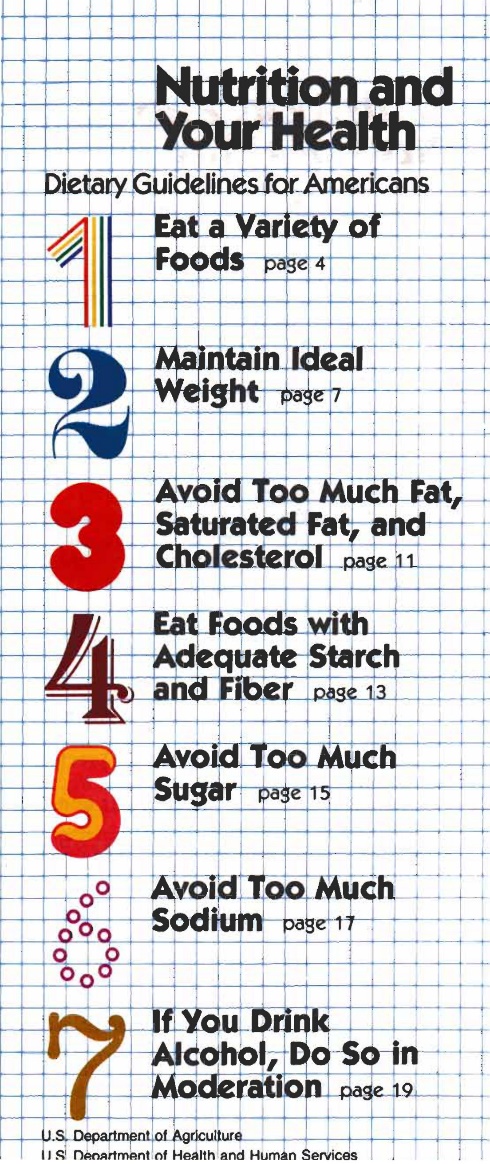
As you can see, “avoid too much fat” and “avoid too much sugar” are equally prominent and identically worded recommendations. Taubes suggests that the statement “avoid too much sugar” is vague and lacks conviction—it is “a tautological statement that could apply to any food.” Yet we are intended to believe that the same language applied to fat altered the course of the American diet.
The Guidelines went further, providing explicit guidance on how to “avoid too much sugar”:
- Use less of all sugars, including white sugar, brown sugar, raw sugar, honey, and syrups.
- Eat less of foods containing these sugars, such as candy, soft drinks, ice cream, cakes, cookies.
In the section titled “Maintain Ideal Weight,” the document lays out its four-part plan for weight loss: Increase physical activity, eat less fat and fatty foods, eat less sugar and sweets, and avoid too much alcohol. Again, the advice to limit fat and sugar intake receive equal attention, and the Guidelines clearly implicate excess sugar intake in obesity.
A person who faithfully adhered to the Guidelines would end up eating a diverse, largely unprocessed diet composed of whole grains, beans, nuts, lean meats, seafood, dairy, eggs, vegetables, and fruits, with little added sugar, added fat, or highly processed foods or beverages. Are we really to believe that this advice—which clearly and repeatedly recommended eating less sugar—made Americans eat more sugar, leading to obesity, diabetes, and coronary heart disease? Having reviewed the Guidelines, the notion strains credulity, but let’s test it anyway.
Wrath of the Guidelines
Taubes argues that the Guidelines may have unintentionally contributed to obesity, diabetes, and coronary heart disease. This rests on the assumption that the Guidelinesthemselves substantially influenced American eating behavior, either directly or indirectly via the food industry, and therefore that changes in the American diet over time can be attributed to it rather than to the numerous other shifts in the American food and cultural landscape that were happening at the time.[4] No evidence is presented to support this assumption, so we will examine it here.
If the Guidelines substantially influenced the American diet, then we should observe that total fat, added fat, and added sugar intake declined in its wake. In perfect contrast to this prediction, our total intake of fat remained approximately the same after the Guidelines, our intake of added fat increased, and our intake of added sugar increased.[5],[6]
Furthermore, we should observe a decline in the consumption of highly processed foods rich in fat and sugar that the Guidelines clearly advised against. To test this prediction, here are the top six sources of calories in the U.S. diet, in descending order of importance, as of 2006:
- Grain-based desserts (cakes, cookies, donuts, pies, and related items)
- Yeast breads
- Chicken and chicken-mixed dishes
- Soda, energy drinks, and sports drinks
- Pizza
- Alcoholic beverages[7]
This list is both disturbing and informative. Cake and related desserts are the number one source of calories in the American diet. Soda, pizza, and alcohol are three of the remaining five items. The average American diet is not even remotely inspired by the Guidelines.
The truth is that we don’t wash down our pizza and cake with beer and soda because we think it’s healthy or because we believe the government recommended it. We do it because we are human beings who are driven by considerations of pleasure, cost, and convenience—precisely the qualities the food industry has been optimizing for the last 40 years.[8]
Taubes assumes that we suffer from increasing rates of obesity and diabetes because we have failed to identify their true cause. Yet the evidence suggests a simpler and more compelling explanation: We eat too much food that is obviously unhealthy, and it’s not because researchers or the government told us to, but because we like it.
A Slow-Acting Toxin
According to Taubes, sugar may be a “toxin” and “the primary cause of diabetes, independent of its calories, and perhaps of obesity as well.” Elsewhere in the essay, coronary heart disease is added to the list. Yet Taubes asserts that this speculative hypothesis cannot currently be tested because there is so little existing research on sugar, and so little interest in conducting such research, that “the research necessary to nail it down would take years to decades to complete and is not even on the radar screen of the funding agencies.”
This belief is remarkable in light of the fact that a Google Scholar search returns hundreds of scientific papers on the health impacts of sugar, many of them human randomized controlled trials, and many funded by the U.S. National Institutes of Health. In reality, the health impacts of sugar are of considerable interest to the scientific community, and as such, they have been studied extensively. Having established that this research exists, let’s take a look at it.
The hypothesis that sugar is the primary cause of coronary heart disease is easily refuted. In the United States, coronary heart disease mortality has plummeted by more than 60 percent over the last half century, despite a 16 percent increase in added sugar intake.[9]Roughly half of this decline can be attributed to better medical care, while the other half is attributed to underlying drivers of disease such as lower cholesterol and blood pressure levels and an impressive drop in cigarette use.[10]This striking inverse relationship is incompatible with the hypothesis that sugar is the primary cause of coronary heart disease, although it doesn’t exonerate sugar.
Is sugar the primary cause of diabetes, “independent of its calories”? Research suggests that a high intake of refined sugar may increase diabetes risk, in large part via its ability to increase calorie intake and body fatness, but it is unlikely to be the primary cause.[11] An immense amount of research, including several large multi-year randomized controlled trials, demonstrates beyond reasonable doubt that the primary causes of common (type 2) diabetes are excess body fat, insufficient physical activity, and genetic susceptibility factors.[12]
The ultimate test of the hypothesis that sugar is the primary cause of obesity and diabetes would be to recruit a large number of people—perhaps even an entire country—and cut their sugar intake for a long time, ideally more than a decade. If the hypothesis is correct, rates of obesity and diabetes should start to decline, or at the very least stop increasing. Yet this experiment is far too ambitious to conduct.
Or is it? In fact, this experiment has already been conducted—in our very own country. Between 1999 and 2013, intake of added sugar declined by 18 percent, taking us back to our 1987 level of intake. Total carbohydrate intake declined as well.[13] Over that same period of time, the prevalence of adult obesity surged from 31 percent to 38 percent, and the prevalence of diabetes also increased.[14]
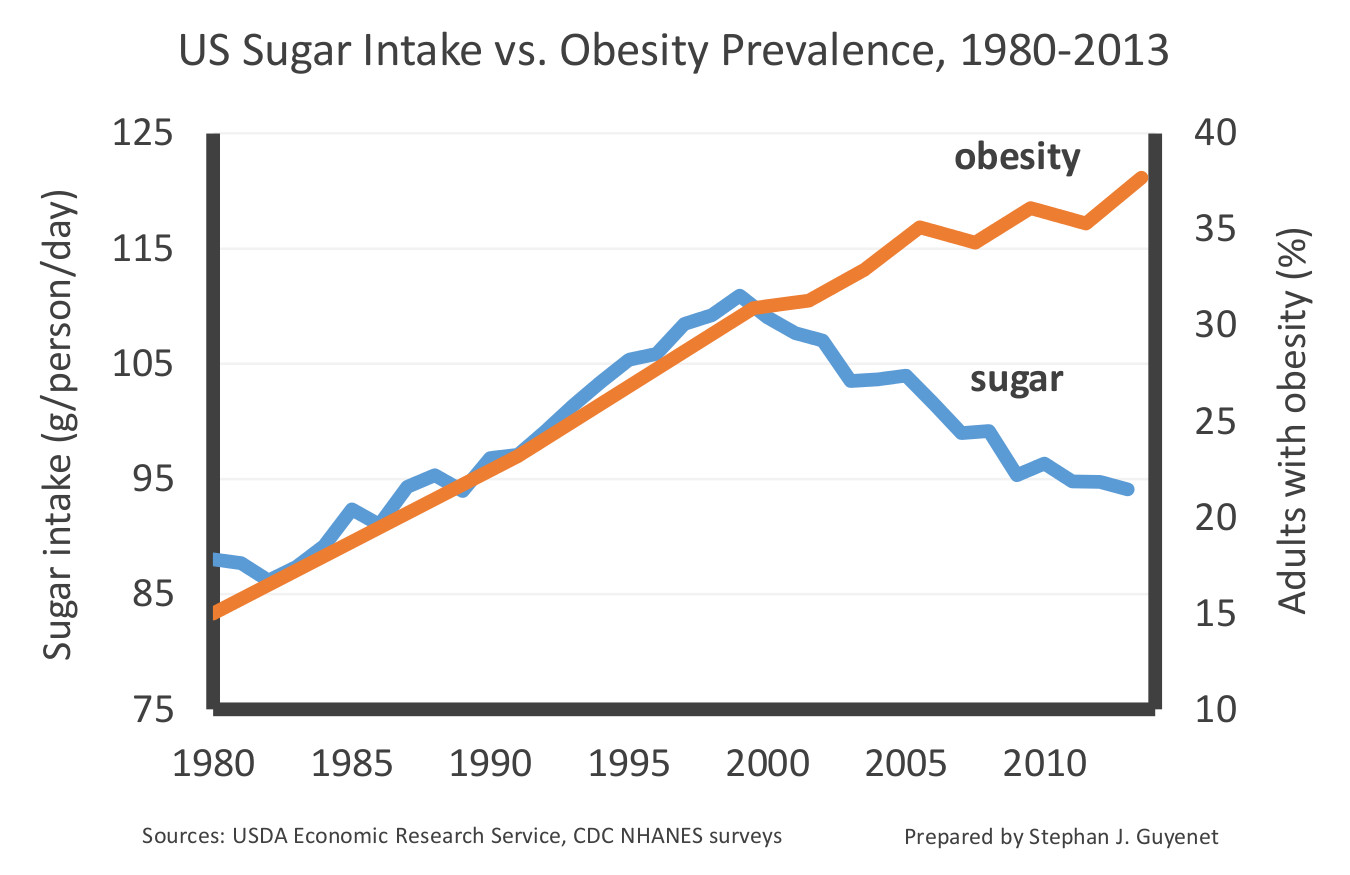
U.S. sugar intake and adult obesity prevalence, 1980-2013. Data are from Centers for Disease Control and Prevention NHANES surveys and USDA Economic Research Service food disappearance records (5,6). Axes are bounded to illustrate correlation, or lack thereof.
Americans have been reining in our sugar intake for more than fourteen years, and not only has it failed to slim us down, it hasn’t even stopped us from gaining additional weight. This suggests that sugar is highly unlikely to be the primary cause of obesity or diabetes in the United States, although again it doesn’t exonerate sugar. Furthermore, it suggests that the laser-like focus on sugar is a distraction from the true, more complex nature of the problem.
I have presented a small piece of a large body of evidence that is more than sufficient to refute the assertion that sugar may be the primary cause of obesity, diabetes, and coronary heart disease. At the same time, this evidence does suggest that added sugar is part of a broader diet and lifestyle landscape that contributes to these three conditions, a conclusion that is not especially controversial within today’s scientific, medical, and public health communities.
Sugar tax
A new paper http://www.nber.org/papers/w21465 looks at the short term impact of the first city-level tax to be levied in the USA on sugar-sweetened beverages which was enacted by the voters of Berkeley, California in November, 2014. It finds that the impact of the tax on consumption has been limited because only half of the tax has been passed on to consumers in the form of higher prices. For Coke and Pepsi, only 22 percent of the tax was passed on to consumers.
It is a reminder that with indirect taxes, the producer/retailer chooses whether to pass on some or all of the tax. It appears that many retailers have chosen - for the moment at least - to absorb the tax by paying some of it themselves.
One factor could be that, as a city tax rather than a state tax, retailers in Berkeley are concerned that passing on all of the tax might lead to frequent "cross-border" shopping.
The Berkeley soda tax is an example of an ear-marked tax in action! Revenue collected from the tax – projected to be $1.2 million in the first year – goes into a Berkeley general fund, part of which has been earmarked for healthy living programmes.
When soda taxes fail (International Business Times) http://www.ibtimes.com/when-soda-taxes-fail-coca-c...
Sugar tax
PROS:
- We know that there is an obesity problem in the UK and that sugar (in addition to other foods stuff) is therefore bad for our health. Other consumables that are bad for our health are already taxed i.e. alcohol and tobacco
- Making fizzy drinks more expensive may see a reduction in how many people have in a day. Not only are sugary drinks bad for your waistline, but it’s also not great for your teeth!
- In conjunction with clear food labelling this would go some way to educate consumers about their diet and daily intake of nutrients
CONS:
- This could be seen as a tax on obesity – is this discrimination?
- We can’t resolve an obesity problem by just cutting out fizzy drinks!
- If someone really wants a fizzy drink, they will pay for it, regardless of the cost.
- The proposed tax would only target fizzy drinks. What about those other sources of refined sugar such as cereals and sweets?
- The tax could mean that people turn to more artificially sweetened drinks such as “diet” versions of the same brand – goodbye sugar, hello aspartamine & saccharin!
- Bigger picture view – we know that some people drink A LOT of fizzy drinks – what support will they be given when they start showing signs of sugar withdrawal (if they stopped drinking fizzy drinks)?
- What about those people who are overweight or obese but it’s because of other foods/drinks they consume….not fizzy drinks!?
I’ll be honest, whilst I thing a sugar tax is a good thing, I don’t think it will make a significant difference to the UK’s obesity problem. There needs to be more accessible support networks, more education, and more focus on nutrition and exercise overall. As personal trainers, it’s often surprising how little any new clients know about nutrition and hidden sugars. Maybe education is a better step forwards than the sugar tax?
PROS: We know that there is an obesity problem in the UK and that sugar (in addition to other foods stuff) is therefore bad for our health. Other consumables that are bad for our health are already taxed i.e. alcohol and tobacco Making fizzy drinks more expensive may see a reduction in how many people have in a day. Not only are sugary drinks bad for your waistline, but it’s also not great for your teeth! In conjunction with clear food labelling this would go some way to educate consumers about their diet and daily intake of nutrients CONS: This could be seen as a tax on obesity – is this discrimination? We can’t resolve an obesity problem by just cutting out fizzy drinks! If someone really wants a fizzy drink, they will pay for it, regardless of the cost. The proposed tax would only target fizzy drinks. What about those other sources of refined sugar such as cereals and sweets? The tax could mean that people turn to more artificially sweetened drinks such as “diet” versions of the same brand – goodbye sugar, hello aspartamine & saccharin! Bigger picture view – we know that some people drink A LOT of fizzy drinks – what support will they be given when they start showing signs of sugar withdrawal (if they stopped drinking fizzy drinks)? What about those people who are overweight or obese but it’s because of other foods/drinks they consume….not fizzy drinks!? I’ll be honest, whilst I thing a sugar tax is a good thing, I don’t think it will make a significant difference to the UK’s obesity problem. There needs to be more accessible support networks, more education, and more focus on nutrition and exercise overall. As personal trainers, it’s often surprising how little any new clients know about nutrition and hidden sugars. Maybe education is a better step forwards than the sugar tax?
Read more
Sugar tax
The pros of a SSBT
The WHO has identified food taxes as a tool to improve population diets[iv]. Taxing unhealthy foods and drinks to reduce consumption for public health reasons is an example of a government fiscal measure and can be effective because price is a key determinant of food choice[v]. Sugar sweetened beverages are a common target for food taxes because they provide energy with little or no associated nutrients[vi].
Modelling by Australian researchers[vii] estimate a 20% rise in the price of soft drinks and flavoured mineral waters would result in an average reduction of 141 g/day to 124 g/day of SSB consumption in men and from 76 to 67 g/day for women, representing a 12.6% decrease. Average energy intake would go down by 16 kJ/day (men), and 9 kJ/day (women). When these modest decreases were extrapolated over 25 years (assuming no other dietary changes), the authors predicted small declines in the prevalence of obesity of about 0.7% in men and 0.3% in women.
They estimate this could to save 1,600 lives, prevent 4,400 heart attacks and 1,100 strokes and save the health-care system up to A$609 million. Even taking into account declines in consumption, they estimate the revenue collected from the tax would be more than A$400m annually which could be “put towards health promotion activities, or used to subsidise healthy foods”.
Of course modelling is always based on assumptions and these may not play out in the reality of implementation. For example, kilojoules may be compensated in other foods and drinks.
KEY TERMSTax: a compulsory contribution to state revenue, levied by the government added to the cost of some goods, services, and transactions.Fiscal measure: in economics and political science, fiscal policy is the use of government revenue collection (mainly taxes) and expenditure (spending) to influence the economy.Demand elasticity: is a measure of how much the quantity demanded will change if another factor changes. One example is the price elasticity of demand; this measures how the quantity demanded changes with price.Cross elasticity of demand: or cross-price elasticity of demand measures the responsiveness of the quantity demanded for a good to a change in the price of another good. For example, when a product becomes more expensive, consumers may switch to cheaper substitutes. Australian research[viii] suggests cross price elasticity exists between SSBs and ‘diet’ soft drinks; a cost increase in SSBs as a result of a tax is predicted to result in switching to diet drinks which would be become cheaper.Subsidy: a subsidy is a form of financial aid or support extended to an economic sector (or institution, business, or individual) generally with the aim of promoting economic and social policy. For example, a subsidy applied to fruits and vegetables would reduce the price to shoppers, increase demand and consumption, and improve health outcomes.
The cons of a SSBT
- Taxing SSBs may not provide the health improvement hoped for in Australia and New Zealand because intake of SSBs is relatively low and declining2. The Australian modelling above is based on 2011 data and consumption of SSBs has declined since then.
- The evidence suggests that food taxes don’t always create the intended result of reducing consumption and when they do the effect is small[ix].
- The potential to improve health is greatest when combined with incentives for choosing healthier foods and this has not always occurred within government regulation frameworks. Governments do not like directing tax to specific purposes but prefer to add it to general revenue.
- An analysis of US studies that linked soda taxes to weight outcomes showed minimal impacts on weight (however they were based on sales taxes that were relatively low)[x].
- A SSBT is what is known as a ‘regressive tax’ because it disproportionally affects poor people. The poor already pay a higher proportion of their income on food and paying more for SSBs may mean they spend even less on nutritious foods.
- Denmark has dismantled their ‘fat tax’ due to a lack of health improvement and unintended adverse consequences such as increased food costs, high administrative burden and tax evasion.
- In a US analysis, the price elasticity of demand for soft drinks was considered high; an increase in price should reduce consumption, however assessments of differences in responsiveness to food prices according to age, education, culture, or ethnicity are not known [xi].
- An increase in food taxes are not always fully reflected in retail prices as companies may absorb part of the cost increase
- Overall, food taxes are seen as punishing bad eating behaviour rather than rewarding good choices and are politically unpopular.
- The evidence on the economic impact of food taxes is limited and this makes government policy makers wary[xii].
Are there any other ideas?
Consuming too many SSBs is a behavioural problem and a behavioural approach would suggest rewarding healthier choices because reward is more effective than punishment [xiii]: when it comes to health decisions, the ‘carrot’ is better than the ‘stick’ [xiv].
In behavioural economics, ‘nudging’ people toward healthier choices by making them more accessible or appealing is considered less paternalistic but still powerful for creating behaviour change [xv].
In a BMJ article2 JT Winkler from London Metropolitan University, UK, suggests making sugar-free drinks cheaper by reducing the margins companies put on them. Sugar-free drinks cost much less to make but are sold at the same price making them more profitable. Removing this “health premium” would make sugar-free drinks cheaper and shift demand in a healthier direction.
Subsidising healthier foods is another example of rewarding healthier choices.
In a US systematic review of fiscal measures for improving public health, cheaper fruit and vegetable prices were found to be associated with lower body weight outcomes among both low-income children and adults, suggesting that subsidies that reduce prices of fresh produce may be effective in reducing obesity7.
Modelling of a 20% subsidy on fruits and vegetables in New Zealand estimated this could result in 560 DPP (Deaths Prevented or Postponed) per year based on 1.9% reduction of all-cause mortality[xvi].
Read more
Sugar Taxes Aren’t Sweet: The Case Against Taxes on Sugar-Based Drinks
Date Written: May 26, 2009
Abstract
Everyday there is a new call by politicians and scholars to place taxes on sugar-based drinks. Sodas, energy drinks, sports drinks, and some juices are increasingly linked as a cause for the obesity epidemic. It is thought that a tax will dissuade individuals from drinking these highly caloric beverages. In addition the revenue collected could be used to help offset the negative health externalities generated by their consumption. A tax of this nature is the text book definition of a Pigouvian tax. However, a Pigouvian tax on sugary drinks would be ineffective at combating obesity for four reasons: it would be under-inclusive; the tax would be too small to adequately deter consumers; tax revenues will decline while the associated health costs will rise; and this tax would be highly regressive
https://papers.ssrn.com/sol3/papers.cfm?abstract_id=1410068
Taxation as prevention and as a treatment for obesity: the case of sugar-sweetened beverages.
Abstract
Sugar Tax
Executive summary
• In the recent Budget, the Chancellor introduced a tax on the sugar content of soft drinks, citing concerns about childhood obesity. This tax will be introduced in 2018 and will not apply to fruit juices or milkbased drinks.
• Government intervention to reduce sugar intake is potentially justified if there are costs associated with consumption that are not taken into account by the individual when choosing what to eat – for example, the publicly-funded health costs of treating diet-related disease or unanticipated future health problems.
• The extent of these costs is likely to vary across individuals and potentially across different types of products.
• Corrective taxes, such as the kind levied on cigarettes, alcohol, fuel and other goods that are thought to have high social costs, should aim to raise the price to bring the costs perceived by an individual into line with the true costs associated with their consumption.
An appropriately-defined tax base can help to ensure that a tax is better targeted at socially costly consumption. The tax base will determine the way that the tax changes relative prices faced by individuals, and hence how they switch across products in response.
• A tax levied on sugary soft drinks has the advantage that reduction in consumption of these products is not likely to directly adversely impact other aspects of diet quality. However, its effectiveness at reducing sugar consumption will depend on the products towards which people switch.
• Carbonated and non-carbonated soft drinks account for on average around 17% of the added sugar that households purchase. Therefore, a tax imposed on these products would target only a fraction of the average household’s total added sugar purchases.
• However, households that purchase the largest amounts of sugar get around twice as much of their sugar from carbonated and noncarbonated soft drinks as households that purchase the lowest amounts of sugar (based on a comparison of the top 20% and the bottom 20% of households’ share of calories from processed added sugar), making a soft drinks tax potentially well targeted.
• In addition, households with children purchase on average around 50% more of their added sugar from carbonated and non-carbonated soft drinks, compared with households without children, which also suggests that a soft drinks tax could potentially be well targeted.
• A broader-based tax levied on a wider range of sugary products would raise the price of products that collectively account for a larger fraction of added sugar, but is likely to be less well targeted – for instance, potentially strongly impacting consumers for whom the rationale for government intervention is weak.
Read more
• In the recent Budget, the Chancellor introduced a tax on the sugar content of soft drinks, citing concerns about childhood obesity. This tax will be introduced in 2018 and will not apply to fruit juices or milkbased drinks.
• Government intervention to reduce sugar intake is potentially justified if there are costs associated with consumption that are not taken into account by the individual when choosing what to eat – for example, the publicly-funded health costs of treating diet-related disease or unanticipated future health problems.
• The extent of these costs is likely to vary across individuals and potentially across different types of products.
• Corrective taxes, such as the kind levied on cigarettes, alcohol, fuel and other goods that are thought to have high social costs, should aim to raise the price to bring the costs perceived by an individual into line with the true costs associated with their consumption.
An appropriately-defined tax base can help to ensure that a tax is better targeted at socially costly consumption. The tax base will determine the way that the tax changes relative prices faced by individuals, and hence how they switch across products in response.
• A tax levied on sugary soft drinks has the advantage that reduction in consumption of these products is not likely to directly adversely impact other aspects of diet quality. However, its effectiveness at reducing sugar consumption will depend on the products towards which people switch.
• Carbonated and non-carbonated soft drinks account for on average around 17% of the added sugar that households purchase. Therefore, a tax imposed on these products would target only a fraction of the average household’s total added sugar purchases.
• However, households that purchase the largest amounts of sugar get around twice as much of their sugar from carbonated and noncarbonated soft drinks as households that purchase the lowest amounts of sugar (based on a comparison of the top 20% and the bottom 20% of households’ share of calories from processed added sugar), making a soft drinks tax potentially well targeted.
• In addition, households with children purchase on average around 50% more of their added sugar from carbonated and non-carbonated soft drinks, compared with households without children, which also suggests that a soft drinks tax could potentially be well targeted.
• A broader-based tax levied on a wider range of sugary products would raise the price of products that collectively account for a larger fraction of added sugar, but is likely to be less well targeted – for instance, potentially strongly impacting consumers for whom the rationale for government intervention is weak.
Read more
Sugar Tax
- It will hit Consumers: The tax is designed to be levied on soft drinks companies, based on the volume of sugar-sweetened drinks they import of export. But the independent economic forecaster, the Office of Budgetary Responsibility, states the costs of the levy will be ‘passed entirely onto the price paid by consumers’. That means it will be the public, not soft drinks companies that end up paying the costs of the new tax.
- It will actually cost the Treasury money: The levy is expected to raise a maximum of £520 million per year. However, because the levy pushes up inflation, the British Government will be hit with a £1 billion bill in 2018/19 because of increased costs of borrowing. And the Government will have to pay this £1 billion up front – before money from the levy finally arrives in the Treasury’s coffers.
- It’s badly targeted: Because fruit juices and milk-based drinks are excluded, it means some of the most-sugary drinks escape the levy. For example, a standard Starbucks extra-large hot chocolate contains 15 teaspoons of sugar – double the recommended daily maximum for an adult. But because it’s a milk-based drink, it is exempt from the levy. The same can be said for other milkshakes, coffee and yoghurt-based drinks.
- The tax will hit the Poorest Hardest: Consumption Taxes always hit the poorest hardest. The poorest 10% of households already pay more than 20% of their gross incomes on duties and VAT – more than double the average household. This tax will only add to that burden.
- It’s poorly designed: The proposed tax is crudely designed with a levy per litre of a sugary soft drink – not by grams per litre. That means many of the drinks with a high sugar content will actually attract a lower tax! The Institute for Fiscal Studies give the example of Sainsbury’s Orange Energy Drink and Coca Cola – two drinks which would be taxed at the higher rate of 24 pence per litre. Three litres of Coca Cola contains 318 grams of sugar – the same amount as two litres of orange energy drink. But because the tax is designed per litre, you would pay 72 pence of tax on three litres the Coca Cola, compared to 48 pence for the energy drink for two litres of energy drink. The tax’s poor design means it fails to penalise the drinks with the higher sugar content.
- It could raise costs all round: The tax is levied on soft drinks companies – not the drinks themselves. To cover the costs, soft drinks companies may raise the costs of other products, not just the sugary drinks. For example, a soft drink company could raise prices on their entire range instead of specifically targeting their sugary drinks products.
- People will switch to other sugary products: The IFS has also suggested that consumers may switch to other products with high sugar contents to get their fix of sugar. Only 17% of added sugar consumption comes from sugary drinks. The tax does nothing to change these underling behaviours which lead people to seek out sugar in their diet. It appears bizarre that yoghurt, cereal, confectionary or chocolate won’t be affected at all by the new levy, despite often containing higher sugar contents than soft drinks.
- It will harm our Pub Trade: £2.8 billion worth of soft drinks are sold in British pubs and clubs each year. That’s nearly double the value spent on cider. In his Budget speech, the Chancellor explicitly stated he wanted to support British pubs and froze cider duty. But the new levy will harm pubs by pushing up the costs on soft drinks – one of their most popular products.
- Soft Drinks Consumption is Actually Falling: As the Government’s own Family Food Survey states, purchases of soft drinks (not low calorie) have decreased 19% since 2011. Moreover, low income households’ soft drinks purchases have dropped 14% from 2007 to 2014. But confectionary purchases have actually risen 1%. It shows the levy is poorly targeted and doesn’t address the underlying causes of sugar consumption, which is not soft drinks.
- Similar Taxes have not Worked Abroad: Sugar Tax advocates point to the effect of a sugar tax in Mexico. But research shows a link cannot be drawn between decreased sugar consumption and the tax being introduced. Moreover, the tax has had a negligible impact on calorie intake and obesity. In developed nations where soft drinks taxes have been introduced, like France, Denmark and US states, they had a negligible impact on calorie consumption and obesity. Will Quince is the Conservative MP for Colchester
Sugar tax
Firstly, economics attempts to achieve the optimal allocation of resources, but the free market doesn’t always achieve this.
If a good has a negative externality, (cost to third party), then there is a strong case for the government to put a tax on a good and make consumers pay the full social cost – and not just the market price. This higher tax reduces demand, raises revenue for government and achieve a more socially efficient level of consumption.
In practical terms, a sugar tax should help to reduce major health issues, such as obesity, diabetes, and tooth decay whilst also raising revenue to deal with these rising health costs.
Arguments for sugar tax
1. External costs. Sugary drinks impose high external costs on society. The overconsumption of sugar is a major cause of health problems such as
- Diabetes (in particular, type 2 diabetes)
- Obesity and obesity related illnesses, such as back pain, heart disease,
- Tooth decay (especially amongst young people
These external costs are reflected in higher costs imposed on the national health service. Poor health also adversely affects work and productivity. Therefore, the social cost of sugar consumption is greater than the private cost of sugar.
This diagram shows the impact of a good with external costs. The free market price is Q1, Price P1. But, the socially efficient level is at Q2 (where SMB social marginal benefit = SMC social marginal cost)
(See original site)
The solution is to impose a tax which raises the price and reduce the quantity to Q2. (See more detail at: tax on negative externality)
2. Demerit good
In addition to the external costs, we can class sugary drinks as a demerit good. This is because people may be unaware of the personal costs involved in sugar consumption. Alternatively, people may be aware sugar is bad for you, but struggle to reduce consumption because of its addictive qualities.
Furthermore, these sugar hits can lead to mood swings. A ‘hit’ of sugar gives a high, but then as the sugar wears off and the body releases insulin to cope with the surge in sugar, it leads to a decline in energy and endurance – which can only be solved by taking more sugar.
The average UK resident consumes 238 teaspoons of sugar per week – but often without realising, because so much sugar is ‘hidden’ in soft drinks, and processed food. This lack of awareness about sugar is an example of information failure – consumers not having full information to make informed choices.
- The amount of sugar in certain foods / drinks
- The harmful effect of sugar
3. Raises revenue
It is estimated a 20% sugar tax could raise approx. £1billion (BBC) This could be used to
- Reduce over taxes (£1 billion is worth about 0.5p on basic rate of income tax) or VAT
- Fund spending on growing health problems of sugar consumption (e.g. diabetes clinics)
From a political perspective, having a tax earmarked to fund spending in a particular area, makes it more palatable for consumers. If they feel tax raised is being used to fund health care / education about health eating, then it feels like a good use of tax raised.
4. Shifting supply and consumption
A sugar tax creates an incentive for firms to supply alternatives which are healthier. If you go into certain fast food restaurants, sugary drinks have often been heavily promoted – e.g. free refills in McDonalds. Here you could argue that supply creates its own demand. But, if firms have incentives to promote healthier drinks with substantially lower sugar content, then consumers will to an extent follow the supply. If you are offered a free coke with a Big Mac, you take it. But, if you are offered free water, you may take that too.
Arguments against sugar tax
1. It leads to job losses. Recently the head of Weatherspoons claimed ‘Jamie Oliver’s plans for a sugar tax would costs pubs millions of pounds and lead to job lossess
“Showboating of this kind by Jamie Oliver will close pubs.” (Independent)
From an economic perspective, it is hard to give too much weighting to the idea that a sugar tax will lead to job losses.
Firstly, it will shift demand away from sugary drinks to non-sugary drinks so it will shift demand within the non-alcoholic market. Ironically, Weatherspoons also said .”Sales of non-sugar drinks in the non-alcoholic category are increasing at a rapid rate and are in the great majority, when you take into account coffee and tea.”
The tax will just accelerate that shift to non-sugary drinks. It’s hard to imagine people not going to a pub because full sugar coca-cola is now 20% more expensive.
It is possible, that the tax will lead to a small decline in the soft-drink market – people may drink tap water and not the non-sugary alternative. It is possible that lower spending on soft-drinks will lead to some decline in market share and job losses. But, at the same time, the sugar tax will be spending £500-£1bn on health care / education initiatives. Jobs will be created in the treatment of diabetes and education of young people about healthy diets. The tax should be employment neutral. It is simply shifting resources from sugary drinks to health care market. (Related article on Luddites and unemployment)
2. It is unfair on low income groups
The sugar tax is regressive because it will takes a higher percentage of income from those on low-incomes. However:
- If people are price sensitive then they can switch to non-sugary drinks and avoid tax.
- Everyone will benefit from the increased health care spending and improved quality of life.
- If there were concerns about income distribution as a result of tax, the tax revenues could be used to reduce other regressive taxes such as VAT, but spending on health care will probably be a better way to improve quality of life for those on low-incomes as they are unable to afford private health care treatment.
3. We shouldn’t make judgements about people’s lifestyle
The other argument about sugar tax is that it is wrong for the government to make judgements about people’s lifestyle and influence consumer patterns.
This is a weak argument.
Firstly, you don’t have to pay the sugar tax, because there are many alternatives to sugary drinks.
Secondly, if a government has a commitment to provide universal health care free at the point of use, it has also has a right to encourage healthy lifestyles which avoid placing undue strains on health care services. Good health care is not just about treating ill health; much better to prevent ill health in the first place.
4. Tax is not the best policy to reduce sugar consumption
Campaigners suggest that other policies, such as banning advertising at children, education initiatives – could be more effective in reducing excess sugar consumption.
However, this is not an argument against a sugar tax. It is merely an observation that we shouldn’t rely on tax alone. The most effective strategy is a combination of policies – education, tax and ban on advertising. The past few decades have shown that demand for cigarettes can be reduced significantly through advertising, regulation and tax. All can play a role.
Conclusion
There is a very strong economic, social and personal benefit from a sugar tax. It will play a role in encouraging healthier diet and at the same time raise money to deal with the rapidly rising health costs associated with obesity and excess sugar consumption.
The only potential losers are the soft drink industry who will see some fall in demand. But, at the same time, there are opportunities for the soft-drink market to produce healthier options which avoid the sugar tax. It will also be good for the national health service.
Overall, there will be a net welfare gain from a sugar tax, with minimal economic disruption.
Subscribe to:
Posts (Atom)