Showing posts with label Meaning of Life. Show all posts
Showing posts with label Meaning of Life. Show all posts

Great advice for use during the day
I’ve been working a desk job for about 2 years now.
While the job is great, sitting all day is very bad for the body and staring at a screen can be tough on the mind.
As a lifelong learner and fitness geek, I’ve found some very unique ways to stay mentally and physically active throughout the day.
Enjoy.
Elevator squats: Mental and Physical
One day, I sat at my desk falling asleep. I tried everything from coffee to pinching myself but this day was a whole new level of exhaustion. This called for extreme measures.
So I got up and headed to the elevators.
I let a couple people go on a separate elevator and waited for one I could catch on my own.
Seeing as how I’m on the 26th floor, I have a nice ride down to the bottom.
As soon as the doors closed, I proceeded to crank out as many body squats as possible before I got to the bottom floor.
I did the same thing on the way up and got back to my desk breathing heavily.
However, when I sat back down I was completely invigorated and fully energized!
Give this a try when you are in desperate need.
Warning: To avoid some embarrassment, make sure to find the elevators without cameras, I learned this the hard way. I continue to do these when needed but I advise saving them for desperate times!
Breath walks: Mental and Physical
When feeling drained, take a walk around the house or office using the 478 breathing method. This will give your brain and body a rush of oxygen to get the energy back. I literally do this every day now.
Podcasts: Mental
We all get those mindless and monotonous tasks at work need to be done. The lack of brain activity can drain your energy quicker than you would think. For these types of tasks, throw on one of these awesome podcasts to help keep your brain active! I also love podcasts for my drives to and from work.
Warning: I don’t suggest listening to podcasts during mentally demanding work, these tasks deserve your full attention.
Hand grippers: Physical
Grab a pair of Captains of Crush hand grippers to bring to work. They are small enough to fit in your lunch bag and at your desk. Squeeze a couple reps every few hours and build that grip strength. My boss and coworkers regularly walk over and give them a squeeze!
Calf raises: Physical
Alone in the restroom or have your own cubicle? Knock out 20 calf raises to pump some blood into the lower body.
Productive meditation: Mental
Take a break and head for a walk. On this walk, have only one thought you want to focus on. Maybe it’s something you’re doing at work or a cool idea you have. Spend the whole walk only thinking about this one thing. When you get distracted, bring the attention back to the one thought. I’m currently doing a 2 week experiment (see end of post) for focus using this and other strategies.
Stomach vacuum: Physical
Work on that tummy any time of the day. Simple practice sucking your belly-button as far in as possible and hold it for 30 seconds. Once you get better at this you can do it while sitting or standing and no one would even know you’re working on your core!
Iso-chest press: Physical
Get a little chest pump on the sly. Put both of your palms together as if you were praying. Begin pressing into both palms and hold this for 10 seconds. You’ll feel it all up in that chest!
Wrist stretch: Physical
Use one hand to pull the fingers of the other hand back to stretch your wrist throughout the day. This keeps them loose if you do a lot of typing.
Chug water: Mental and Physical
The next time you’re dragging, resist the coffee and chug some water. This will give you a little boost and keep you going. Keeping yourself hydrated is a great way to keep the brain and body in good working order.
Shoulder stretch: Physical
Loosen your shoulders after long periods of sitting. Link your fingers together behind your back. Now gently push your hands toward the ground and feel the stretch in your shoulders and chest.
Standing on one leg: Physical
If you catch me in our break room heating up my lunch, there is a great chance I’m standing on one leg. I’m not talking about having the other leg way up in the air, just slightly lifted off the ground. This gives a little balance challenge and nice burn in the ankles to give you a little energy boost throughout the day.
Walk to the restroom in a new direction: Mental
Your brain gets used to routine, change up the routes you walk daily to spice up your day.
Pomodoro method: Mental
Instead of trying to do your work for hours on end, take mental sprints to be more efficient. Give yourself 25 minutes completely free from distractions to really get after your work. Take a 5 minute break and do it again. You’ll find that this method allows you to stay focused easier than working for hours without a rest. Check out this post for more on managing your time.
Healthy snacks: Mental and Physical
If you’re really tired throughout the day, your body is telling you something. Either you need more sleep or you need to re-fuel. Healthy snacks like boiled eggs, peanuts, avocados, peanut butter, and greek yogurt can all help bring you back to life. And yes, I do eat all these within one work day, don’t judge me.
Read at lunch time: Mental
If you get a break a lunch, get the heck out the office and get outside. Bring a book with you and give yourself 20 minutes to catch up on some reading after you eat. This will give you some time to digest your food and re-charge your brain!
John Michael Domingo, Writer. Learner. Martial Artist. Christian.
Routines
verything you need to know about successful morning routines.
How you start your day is how you live your life.
Start with energy, conviction, and direction; your life will be full of success, happiness, and fulfillment. By the same standard, if you start your day behind the eight ball, you’ll struggle more to optimize your health, wealth, and mental capacity.
So the secret, it would seem, is waking up early.
This simple act has been proven time and again by the greatest men and women in history to impact their increased success. In the following pages we unearth the a.m. rituals of the greats, from Ernest Hemingway, Benjamin Franklin, Maya Angelou, Anthony Bourdain, Dwayne “The Rock” Johnson, Andrew Carnegie, and more, with the singular goal of distilling an ultimate guide to the best morning routines ever created, and how we can use this information to create our own.
What we have discovered in our extensive research on morning routes is that a combination of science, physiology, and cultural norms are set up to support early risers. Furthermore, it’s been that way through all of history, in every tribe, on every continent.
Today the revelation that the most successful businessmen and women all share the same habit of waking with the sun is chewed on by every news syndicate and lifestyle publication. However many of these articles are misleading, in that they don’t get to the root of what makes a morning routine successful. We’ll dig into that here.
Why?
Because as humans we’re hungry to know what hour exactly Bill Gates and Arianna Huffington set their a.m. alarms and what actions they take once the chime sounds that lead to such profound success. Because we want to be successful too. And if all it takes is waking up early— not a $10,000 pill or advanced morning wake-up machine— it’s achievable.
Science Says Waking Up Early Might Be Hard (or Easy) For You… But It Will Make You Better

Science and research has determined that for some people, waking up early (we’re talking 5 a.m. and not 10 a.m.) is simply easier. This is determined largely by an individual’s natural chronotype— the behavioral manifestation of our circadian rhythms, based of the propensity to sleep at a particular time within a 24-hour period. Our circadian rhythms ebb and flow at different hours, determining when we normally feel most awake or most tired.
Despite these variants, it’s a universal human inclination to want to press the snooze button if we feel tired in the morning. Our cognition is also naturally weaker in these early hours, making it easier to succumb to fatigue. The mental pathway for hitting snooze says, ‘I’m giving myself a few extra minutes to relax, collect my thoughts, and gain rest.’ But what hitting snooze actually does is make the wake-up process more difficult[1]. And if you happen to fall back asleep, it plunges your brain back into the beginning of your sleep cycle—physiologically the worst state to be woken from. Ian Parker, a writer for The New Yorker, the Independent, and London Observer says, “the harder we feel it is for us to wake up, the worse we think we’ve slept.”
But even if your biological clock makes it difficult to rise early, and have energy in those morning hours, researchers have found that our ability to adjust to different time zones proves we can override much of this natural inclination and reset our circadian rhythm. That means obliterating the inclination to hit snooze.
We might wonder if such a reset is even possible. It most assuredly is.
Basic training for the US military consists of reshaping men and women with disparate backgrounds into a well-oiled machine. Here’s how they describe the 5 a.m. wake-up :
In military basic training, there’s no such thing as sleeping in. You’ll get up at 5 a.m., every single day.
Waking up in the morning is an adjustment process that’s the same for every single basic training class. When you first arrive, the drill instructors require a lot of noise, yelling, and jostling to get everyone out of the rack. Then, sometime around week 4, all it takes is for the drill instructor to enter the room in the early morning and quietly say, “Get up,” and everyone pops out of their bunks immediately and begins their morning routine. It’s an amazing adjustment.
Perhaps this was the basis for the Army slogan, “We get more done before 9 a.m. than most people do all day.”
In the end, it may biologically never be as easy for you to wake up at 5 a.m. as it is for others, but it’s possible nonetheless. Winston Churchill, for instance, physically got out of bed at 11 a.m., but he was diligent about cognitively waking up at 7:30 a.m.[2]
Lose an hour in the morning, and you will spend all day hunting for it. – Richard Whately
The Research of Why Early Risers Are More Successful
It’s well worth the process of adjusting your circadian rhythm to become an early riser, as time and again it’s proven the early bird really does get the worm. (You knew that analogy was coming.)
The most significant research done to correlate successful human characteristics to waking early was done by Harvard biologist Christopher Randler in 2008. Randler surveyed 367 university students and found a higher percentage of morning people agreed with statements like “I spend time identifying long-range goals for myself” and “I feel in charge of making things happen.”
That same year, a Texas University study found college students who identified as “morning people” earned a full point higher on their GPA than self-proclaimed “night owls.” Meanwhile a slew of other studies have connected being a morning person with being more optimistic, agreeable, and having more satisfaction and conscientiousness.
The common retort to these results is to pull up research that connects night owls with having a better sense of humor and being more creative.
This, we are not debating. And perhaps if the cultural structure of 9-5 workdays was instead 4 to midnight, night owls would be the ones reaping the rewards. But alas, the 9-5 isn’t going anywhere, and as it stands today, having a morning ritual before getting to the office at the 9 a.m. punch-in is the leading indicator of more personal and professional success.
That’s because in terms of health, “night owls” are 1.5 times more likely to become obese than early birds, two times as likely to be physically inactive, and 2.9 times more likely to veg out in front of the TV or computer.[3] This same study found that even if both a night owl and early riser clocked equal time sleeping, with the variable being the early riser went to bed 70-90 minutes earlier, the sleep was more restorative and led to healthier life habits for the earlier riser. Additionally, poorer sleep is connected to increased use of alcohol, cigarettes, and caffeine.
Early risers, in fact, have a completely different brain structure than night owls. A German study showed that the latter had reduced integrity of the brain’s white matter (this facilitates communication between brain cells), which is more likely to lead to depression and other cognitive impairments. So not only does society reward the early riser, but our physiology does too.
Try this quick social experiment if you really don’t believe the hype. Go to Google and begin typing, “Success and waking up…” Notice what the autofill immediately suggests, how many articles there are to support that claim, and whether you see the word “late” anywhere.
Sooner or later, the great men turn out to be all alike. –V.S. Pritchett
I Woke Up Early, Now What?: A Look at Routines
If you associate with being a ‘night owl,’ or if your life or job requires you to work late in the evenings, you can still establish systems to override the inclination to sleep late, and instead wake to the dawn, control this time, set the tempo for your day, and achieve great things in life.
According to the New York Times, “There’s a lot of power in having a morning routine. It reduces decision fatigue and can help you be more productive through the day.”
Powerful morning routines are not a fad. They have been embraced in both Eastern and Western cultures for time immemorial. There are records of Jesus himself practicing a regular Morning Prayer routine before traveling to new towns to teach and heal.[4] Meanwhile Buddha’s routine ran from 4 a.m. to noon, and consisted of first washing, then meditating, going out to help the needy or beg for food, then lunch and discourse with those who welcomed him into their home. [5]

On a cultural level, people living in 1920s Japan practiced Rajio Taiso (radio calisthenics) every morning, simulating a short circuit of dynamic stretching, joint mobility exercises, and bodyweight drills. This was done by both young and old to piano music broadcast over Japanese public radio. Today, around 20% of the population still carries out this morning routine. China and Vietnam have their own versions of this morning movement ritual, usually involving arm swings, hand clapping, toe touching, and very light cardio circuits in a park.
In India, many practice Ayurvedic rituals— an ancient healing practice that puts emphasis on a balance between the mind, body, and spirit. Many practitioners choose to start their day with these rituals, which could entail gazing at their hands, drinking warm water, and pouring water to the sun.
The development of individual (as opposed to cultural) morning rituals means our routines are becomming more personalized; in the sense that what works for you might not work as well for me, and vice versa. However, there are distinguishable similarities between many of the most successful morning routines in history… which we’ll talk about a little later.
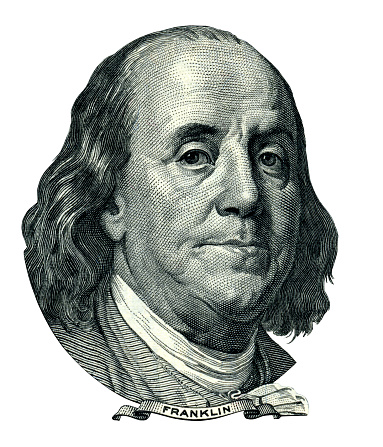
One of the most infamous early risers (thanks to his immortalizing “Early to bed, early to rise…” quote), Benjamin Franklin woke at 5 a.m. and asked himself, “What good shall I do this day?” He would then plunge into reading, writing, and other work until going to bed at 10 p.m.
No other aspect of Franklin’s daily schedule stands out other than his morning routine to rise early, begin thinking about the most important to-do for the day, start work, and be unfaltering in this routine.
German philosopher Immanuel Kant also woke at 5 a.m., being roused by his servant Martin Lampe who was under orders to be persistent so that Kant would not sleep longer. “Kant was proud that he never got up even half an hour late, even though he found it hard to get up early,” writes Manfred Juehn in a biographical sketch of the philosopher. “After getting up, Kant would drink one or two cups of tea — weak tea. With that, he smoked a pipe of tobacco…He then prepared his lectures and worked on his books until 7:00. His lectures began at 7:00, and they would last until 11:00. (No mention of how early his servant had to get up!)
Fellow countryman and acclaimed philosopher Friedrich Nietzsche held a similar Spartan-like dedication to waking up early. He rose before dawn, washed in cold water, drank some warm milk, and worked uninterrupted until 11 a.m.
What’s astounding about this trend is that you might believe waking early is only beneficial for advanced thinkers, academics, or Wall Street executives, but the habit has been credited amongst the best, most successful people in almost every profession.
The famous American dancer and choreographer, Twyla Tharp, extolls in her book The Creative Habit, “I begin each day of my life with a ritual.” Hers begins at 5:30 a.m., where she wakes and puts on workout clothes, walks outside her Manhattan home, hails a taxi, and goes to the Pumping Iron gym to work out for two hours. “The ritual is the cab. The moment I tell the driver where to go, I have completed the ritual.” She adds that this ability to harness the power of morning ritual is transferable to all other areas of her creative, professional, and personal life.
The brash and bold chef Anthony Bourdain, even during his time working the line, would get up between 5 a.m. and 6 a.m. to start typing his book Kitchen Confidential— which would go on to become a New York Times best-seller and adapted into a television series by the same name. The groundbreaking author Maya Angelou also had a ritual to write in the morning. She got up at 5:30 a.m., had coffee by 6 a.m., and left the house to go to a hotel room, which she kept to do her writing. There, her ritual was to work until 2 p.m. Victor Hugo, the mind behind Les Miserables,rose at dawn, took coffee, ate two raw eggs, then wrote until 11:00 a.m.

Browsing the archive of most successful composers in history we find the thread continue. Ludwig von Beethoven kept a ritual of waking at dawn, drinking his morning coffee (obsessively counting out 60 beans per cup), and composing until early afternoon. Tchaikovsky, who composed such classics as The Nutcracker and Swan Lake, got up before 8 a.m., read, went for a walk, completed the chores he most disliked, and sat down to compose at 9:30 a.m.
Architect Frank Lloyd Wright drew out the sketches of what would become some of the most profound architecture of the modern age between 4 a.m. and 7 a.m., when his “mind’s clear.”
Professional WWE wrestler turned highest paid actor in the world (2016), Dwayne “The Rock” Johnson is no exception to the rule. He wakes up at 4 a.m., drinks coffee, and then does cardio. Johnson wrote on Instagram, “I’m up at 4am daily and puttin’ in the hard work that I already know my competition is not willin’ to do. If they’re willin’ to get up at 4, then you bet your ass I’m gettin’ up at 3.” This text accompanied an image of Johnson lifting weights, and was taken on his birthday.

Average Joe, Mark Webster, took note of The Rock’s unique routines and set out on a personal mission to follow them for 30 days, documenting the progress. During the experiment, Webster found that one reason the super-athlete completes his workouts in the morning is because tackling challenges head-on in the morning encourages similar behavior for the rest of the day.
Roy F. Baumeister, a psychology researcher at Florida State University says, “The longer people have been awake, the more self-control problems happen.” Baumeister pinpoints the evening as being the time when most things “go bad,” whether it’s diet, physical activity, or even criminal tendencies. Baumeister says the most impulse crimes are committed after midnight.
The glaring truth is that the first couple hours of your day are likely to be your most productive, and likely to set the tone for the next 16.
If it’s your job to eat a frog, it’s best to do it first thing in the morning. And if it’s your job to eat two frogs, it’s best to eat the biggest one first. –Mark Twain
What Not to Do in a Morning Routine
We’ve backed the claim that you should (and can) wake up early. We saw the life success benefits of those who implement a morning routine. And now we want to know what NOT to include in that routine.
In order of occurrence, you should not:
- Stay up late
- Forget to plan
- Hit snooze
- Overplan
Going to Bed on Time
In today’s always-connected world, it can be harder to go to sleep early since we’ve become constantly distracted by notifications. Missed calls, mindless browsing, messages, likes, shares, etc. Young people especially find it hard to shut down and call it a night, and are then woken early to more notifications that cannot be ignored.
One of the advantages the military life has when resetting sleep clocks is that trainees are physically and mentally exhausted, and purposefully so, by 9 or 10 p.m. at “lights out.” Sleep then becomes a biological need, as much as eating when hungry.
Planning Ahead
Instead of browsing Facebook, during our last evening hours we should be planning the day ahead. This simple action of scripting the next day has proven to help you sleep better and get started quicker come sunrise. Instead of worrying about what you didn’t complete today and the trials tomorrow might bring, you have a plan; some assurance of what is essential for tomorrow.
According to a recent survey by The New York Times, only 10% of people properly plan their days the night before. But building your fast-start routine gives you a substantial head start; especially if that planning is taken seriously.
One of the biggest mistakes people make is waiting until the morning to begin planning their day. Andrew Carnegie, the famous steel magnate of the early 1900’s, knew that you should finish each day listing your top 3-5 tasks for tomorrow before you go home at night. Doing this has two benefits. First, it tells your subconscious mind to work on these problems while you sleep (and when you wake up, you focus your fifteen minutes in the morning on turning your overnight ideas into moneymaking solutions). Second, it allows you to get off to a fast start in the morning, rather than wasting time getting organized.
Saying No to Snooze and No to Over-planning
We’ve already covered the adverse effects of hitting snooze, but less mentioned are the negative impacts of over-planning. If you notice from the morning routine examples above, the most successful ones are simple. They are made up of small action cues that done in daily repetition set up the mind and body for the production of writing, art, work, or whatever the task/trade might be.
“Your schedule – in at about the same time every day, out when your thousand words are on paper or disk – exists in order to habituate yourself, to make yourself ready to dream just as you make yourself ready to sleep by going to bed at roughly the same time each night and following the same ritual as you go,” says acclaimed horror writer Stephen King. He follows this advice by writing at 8:30 a.m. at the latest every day, and doing simply that until the early afternoon.
Article lists from popular publications claiming, “The 14 Things Successful People Do Before Breakfast,” or “8 Things Successful People Do Before Breakfast,” are misleading. These are archives of small actions, from drinking water to taking a shower, that do not work as a total prescriptive grocery list for success. The small stuff will vary and it will take care of itself. It is not essential to do everything, but only what works to optimize your own routine with the end goal of pushing your life’s work and goals further during a period primed for compounded results.
The Rock literally wakes up early, drinks coffee, and performs bodily movements that raise his heart rate. Simple. Instead of focusing on the exact roll call of routine actions, it becomes more significant to dwell on having the discipline to follow your morning structure, day in and day out.
Margaret Mead, the American cultural anthropologist sealed in the archives of history for her saying, “Never doubt that a small group of thoughtful, committed citizens can change the world; indeed, it’s the only thing that ever has,” was notoriously strict in adhering to her morning routines— so much that once at a conference she planned to postpone her morning writing ritual to attend a session that was cancelled at last minute. She exclaimed, “How dare they? Do they realize what use I could have made of this time?”
Rigorously and unapologetically protecting your morning routine is a characteristic of the great. Reading the front page of the newspaper or running around the block, not always.
Three Parts to a Perfect Morning Routine: Cleanse, Center, Kickstart

Kerri Baker (pictured above), a Certified Personal Trainer and Certified Sports Nutritionist, was struggling to find her passion and purpose after her younger brother died. She relied on alcohol to numb the pain and pass the hours of the day. Then she read The Perfect Day Formula— a book by Craig Ballantyne that emphasizes the importance of creating daily routines that thrive off personal discipline. Baker had negative connotations with the ideas of perfection (as mentioned in the title) and structure for so long, but she found a kinship with the author’s own journey from anxious wreck to 7-figure life coach.
The morning after starting the book, and despite having a terrible hangover, Baker rose at 5 a.m. and began to use the power of morning routine to change her life. Within three months she reported feeling completely transformed. She had dropped 10 pounds, 6% body fat, was meditating every day, and leading her clients with new levels of energy and engagement.
All because one morning she made the decision to wake up at 5 a.m.
Baker’s story proves that there are really only three elements to a successful morning routine that need to be accounted for. Those are Cleanse, Center, and Kickstart.
Australian fitness guru Chris Dufey has been tinkering with this system of three morning routine elements for years. Here are suggestions, from Dufey and other gurus, to get you started on crafting your own. In the end, you can make adaptations or substitutes based on what works for you. As Burt Rutan said, “testing leads to failure, and failure leads to understanding.” After testing these Cleanse, Center, and Kickstart morning routines, you’ll have a sense of what yours needs to look like.
 Chris Dufey
Cleanse: Drink 1 liter of water with lemon juice
Center: 20 minutes of meditation
Kickstart: Journaling. “At the end of my journaling I write about two things,” Chris explains. “One is what I will be proud about that I’ve done today, and the second is what I’m grateful for. I try to write with such vivid clarity to bring about emotion where I can feel the ‘tingles’.”
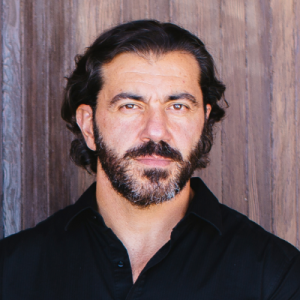 Bedros Keuilian
Cleanse: Drink water
Center: Take the dog Cookie for a walk
Kickstart: Five-minute gratitude exercise
 Craig Ballantyne
Cleanse: Organify, vitamin C, glutamine
Center: Time with the dog
Kickstart: Open iTunes and listen to the same Arthur Rubenstein recording of Frederic Chopin’s Noctures, and my brain says time to write 1000 words.
Breaking down the elements, cleansing is the action of refreshing the body in some way, whether it’s using vitamins or drinking plain old water. The simple act of washing away the stale and the tired, whether it’s an internal cleansing or a bracing shower, resets us physically, a kind of “rebooting.” Like a shock to the system and a clear divide between slumber and wakefulness.
Centering then becomes the action of creating a level plane to operate from, and should somehow prepare you mentally for the Kickstart, which needs to relate to your biggest goal or to-do for the day.
The more free time we devote to shaping our minds, the better off we will be. I recommend waking up early to use the morning to meditate. -Dalai Lama
The 15-Minute Wake-Up Hack
Lee Iacocca, the former CEO of the Chrysler Motor Company, once complained he didn’t have a spare fifteen minutes per workday to focus on the big issues. And even us non-Chrysler-CEOs feel this lack of time.
You get to the office, your coworkers are at their desks, some asking, “did you get my email?” and you sit down to a schedule of meetings and calls from now through 5 p.m. When are you supposed to do the big thinking?
The answer: in the first 15 minutes after you wake up.
In The Perfect Day Formula, Ballantyne begins by recommending his readers wake up only 15 minutes earlier tomorrow than they did today.
What you’ll find in those 15 minutes is a quiet space that exists nowhere else in your day. The kids aren’t running around the kitchen, but instead it’s dark and quiet. Traffic has not collected and you ease through your commute without horns or stop-and-go brake pumping. The office is empty and you become the owner of that space, being able to focus completely on your top priority.
This is you running your day.
Even Hemingway, despite his legendary hangovers, would write at 6 a.m. because “There is no one there to disturb you.” He said in an interview with The Paris Review, “I write every morning as soon after first light as possible… and it is cool or cold and you come to your work and warm as you write… You write until you come to a place where you still have your juice and know what will happen next and you stop and try to live through until the next day when you hit it again…. It is the wait until that next day that is hard to get through.”
There’s creative power in the first 15 minutes of the morning, and you’ll find very few people take advantage of it.
In the morning a man walks with his whole body; in the evening, only with his legs. — Ralph Waldo Emerson
But Really, Go to Bed on Time: The 10-3-2-1-0 Formula
Here’s a simple math equation: If your odds of being more successful increase when you wake up early, and tomorrow you need to wake up 15 minutes earlier than you usually do, what time do you need to go to sleep tonight?
Earlier.
For years the successful entrepreneur and CEO of Fit Body Boot Camp International, Bedros Keuilian, struggled to control his mornings because he felt rushed throughout the day, which then led to strong feelings of anxiety in the afternoon and evening.
He put into place a new system of waking up earlier, plus other daily habits outlined in The Perfect Day Formula, which changed his living structure completely. Keuilian says, “The system helped me overcome afternoon anxiety, gave me control of my day again, and helped create more time in the evening to enjoy my family rather than play catch up. I no longer work in the evenings and that means my work is of better quality because I think and process better in the mornings.”
He concludes, “The single most important factor in winning your mornings and owning your days is to get up 15 minutes earlier and work on your number one priority before anyone else is awake.”
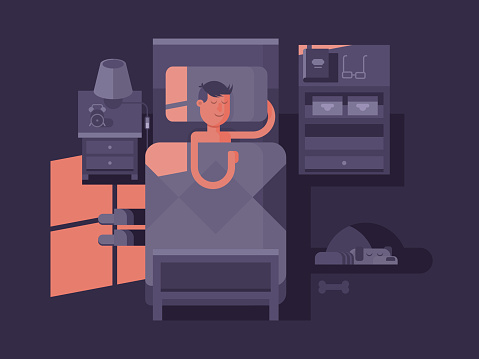
Going to sleep at the right time is much like getting up earlier: it’s the simplest of tasks that feels as though it takes a horde of discipline. Without using willpower or wishes, the 10-3-2-1-0 Formula is currently the most successful system that allows for early to bed, early to rise.
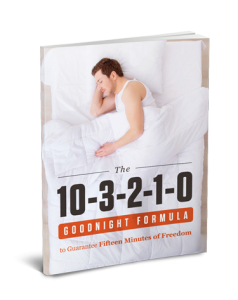 How it works:
10 hours before bed – No more caffeine
3 hours before bed – No more food or alcohol
2 hours before bed – No more work
1 hour before bed – No more screen time (turn off all phones, TVs and computers)
0 – The number of times you will hit the snooze button in the morning
Ballantyne, the creator of this Formula, explains…
- Stop drinking all caffeinated beverages 10 hours before bed. This is generally the amount of time required for your body to clear it from the bloodstream and eliminate its stimulatory effects.That seems like a long time, but the metabolic half-life of caffeine is over 5 hours. In the ten hours since lunchtime, that 200mg cup of coffee still has 50mg in your system.
- Finish eating big meals and drinking alcohol 3 hours before bed. This will help you avoid heartburn (gastric reflux) and interrupted sleep. Alcohol might make you feel sleepy, but it impairs your natural sleep cycle and interrupts valuable deep sleep. The reflux is partially positional – stomach contents, like any liquids, move when you lay down. Better to have an empty stomach.
- End all work-related activities 2 hours before bed. No more taking phone calls, checking emails, reading reports, or thinking about tomorrow.
*At this point, plan for tomorrow by scripting your day, including a Brain Dump. This takes five minutes and requires nothing more than a blank piece of paper and a pen. Craig Ballantyne explains, “Write down everything going through your head. Write fast and furious. Get it all out. Now take that paper and set it aside, perhaps in your office or at the front door under your car keys. Now forget about it for the rest of the day. It can wait until tomorrow. That will help clear your mind.”
- Turn off all electronics 1 hour before bed. The blue light emitted from screens makes it difficult to fall asleep. Spend the final hour reading real books, talking with your spouse, meditating, taking a bath, or enjoying other activities in the privacy of your bedroom – but do not use your iPhone or tablet. It’s at least partly about pacing here. “Screen time” is designed to present more information in a more engaging fashion – and this is true for entertainment as well as “real” information. The visuals demand more attention and engagement, making it harder to disengage and relax. It takes time to slow down and turn thoughts inward. (In fact, shutting your eyes and turning off the “visuals” is a good practice generally for deeper thinking or meditation.)
- Hit the snooze the next morning 0 times. This is the last temptation to avoid. If you wake up to the sound of an alarm, you will be tempted to hit the snooze button. Don’t. Not only will it make you late for your scripted day and interfere with winning your morning, but going back to sleep for a few minutes actually makes you more tired than if you had started your day immediately. Many people who adopt this routine find they wake up slightly before the alarm goes off. They wake up naturally and shut the alarm off before it sounds.
Ballantyne recommends placing your alarm across the room, making you get up, leave your bed, and walk a few steps before you can turn it off. “By then, you’re more awake and it’s easier to resist the allure of snoozing.” A second, more stoic, approach is to “internalize the benefits of getting up immediately,” Ballantyne adds.
“Remember why you are doing this. It’s your one and only life, one that is not rewarded for staying in bed, one that does not move forward because you stole an extra five minutes of sleep. If you want more sleep, you need to get to bed earlier, not wake up later.”
“Making a lot of money is great,” says Bedros, “but having the freedom to enjoy it without the feeling of stress and anxiety is happiness.”
Final Takeaway: Morning Routines Rule
Morning routines quite literally rule. They govern the habits that dictate our health, wealth, and mental wellbeing. But make no mistake, this is not a cheap trick or technique, it is part of an overall package meant to improve and enhance life – success is just one benefit.
And to bind it to the larger picture, let us consider “the sleep of the just.” The context is discovering what constitutes a good and meaningful life, well lived…
When a man expends all his will and energy in pursuit of his own goals and ambitions, and not the dreams of another, he may be frustrated by circumstance or thwarted by the Fates, but he will be blessed when, at the end of the day, exhausted, he takes to bed, for then he is granted a deep and untroubled slumber – the sleep of the just – and with new vigor, anxious, he will rise early and greedily accept the gift of a new day, eager to face the challenges, vibrating with excitement and enthusiasm.
—————————————————————————————-
[3] This study was done in Australia on a teenage population.
[4] http://reflectingtheimage.blogspot.com/2013/01/jesus-routine.html, http://jesushacks.com/discipline-routine/
5 am?
Do I really have to wake up at 5 a.m. to be successful?
Before social media became a popular way to catalog our lives, “Keeping Up With the Joneses” simply meant trying to one-up your neighbor with the size of your house or model of your car.
But Facebook and its ilk, combined with a perverse new competitive mindset, has turned everything in life into an “I’m better than you” conversation.
Recently, social media has taken a bizarre turn into our daily routines. People are making their wake-up time into a competition and boasting match.
You might have heard about the 5 a.m. badge of honor.
Inspired by a book about waking early, the idea is that you have to get out of bed every day at five in the morning.
“Join The 5 a.m Club. Your most valuable hours are 5 a.m. – 8 a.m. They have the least interruptions,” says best-selling author Robin Sharma.
He’s right about this time having the least interruptions. I also believe the morning is magical for not only productivity but also creativity.
However, I also believe that the 5 a.m. club is a bad idea.
You might be surprised to hear that, coming from a man who wakes up at 4 a.m. While it’s true that the morning is magic, and that getting up earlier is the easiest way to get ahead in life, I don’t believe you need to get up as early as 5 a.m.
I just don’t believe you need to get up at 5 a.m.
Frankly, that’s not reasonable. It’s unnecessary.
I cringe when people write about how they went, literally overnight, from getting up at 8 a.m. to getting up at 5 a.m.
Those people won’t last. They’ll suffer from self-imposed jet lag, and because of the consequences, they’ll come to despise waking up early. And then they’ll return to sleeping as late as humanly possible each morning before they have to get up in order to make it to work.
Worse, twenty percent of the population has a biological clock that makes them most effective late at night. Expecting “night owls” to wake-up 5 a.m. is sentencing these people to failure.
SUGGESTED: 10-3-2-1-0 Formula to Get More Done
Forget about forcing a 5 a.m. alarm into your life.
Let me tell you the real secret to taking advantage of your magic time in the morning.
You simply need to get up fifteen minutes earlier, not three hours earlier.
I’ve been around the block in this world of habit change. In my Turbulence Training fitness business, we’ve held over 25 before-and-after weight loss transformation contests. I’ve read hundreds of letters from people that have successfully changed their routines. But I’ve also read twice as many comments from people that have failed to make their habit changes stick.
The common factor in all of those failed stories was trying to do too much at once.
SUGGESTED: The Ultimate Guide to Morning Routines
Getting up three hours, two hours, an hour, and even thirty minutes earlier than usual is too much. I know from personal experience.
It’ll make you miserable and leave you tired all day. Changing your wake-up time so dramatically often requires weeks for proper adaptation.
The answer is not in taking big bites. The answer is to nibble away at your wake-up time. The answer is to attack your morning in a reasonable manner.
Let me tell you about how I made the change from sleeping in to getting up early.
I distinctly remember the day in 2007 when I woke up in my downtown Toronto condo at 7:35 a.m. I rolled over, grabbed my phone, and began checking my email.
Thirty minutes later, after being taken down a rabbit hole by one particular email that left me stewing, I realized my morning routine was wrong, wrong, wrong.
Waking up late was making me anxious because I’m a natural morning person. I like to get things done before most people start their day. That meant I needed to get up earlier, and so I started to change little by little.
The next morning the alarm was set for 7:30 a.m. Two days later, I moved it back to 7:25 a.m. The next Monday it was 7:20 a.m., and within a few weeks of these easy transitions, I was comfortably waking up at 6 a.m.
Today I get up earlier, but I eased myself into these new habits. Now it’s almost impossible for my body clock to allow me to sleep past 6 a.m.
It’s a habit that has changed my life. But you don’t need to go as far as I’ve gone.
You simply do not need to join the 5 a.m. club, and quite frankly, if you’re currently a member of the 7 a.m. club, and you try switching allegiance tomorrow, you’ll pay an awful price.
There’s no value in wearing your wake-up time as a badge of honor or feeling superior because you get up earlier than someone else. What really matters is that you are making the right decisions for your right life.
Is it right for you and your family to be up at 5 a.m.?
Is it right for you and your family and your future to be making the sacrifices that one must make in order to get 7-8 hours sleep and get up at 5 a.m.?
Is it right for you to go to bed at midnight and get up at 5 a.m. every day?
I can answer the last one for you.
No.
If you’re sacrificing sleep in order to get up at 5 a.m. — for no good reason other than to be part of a masochistic club — then you’re making a bad decision.
The 5 a.m. club is definitely not for you if:
- You currently get up at 8 a.m., 7 a.m., or even 6 a.m.
- You can’t get to sleep before 10 p.m.
- You’re a night owl.
- You’re family or social schedule simply don’t permit it.
- You have no idea what you’d do at 5 a.m.
Ignore the dogma.
Use this better approach instead.
Focus instead on getting up fifteen minutes early tomorrow. Be the first one out of bed in your house and take advantage of this solitude.
Go downstairs and sit at your kitchen table, armed only with pen and paper. Identify your number one priority in life. It could be the number one problem causing you stress, or it could be your greatest opportunity. Spend these fifteen magical minutes focused on identifying ways to solve the problem or take advantage of the opportunity.
For example, if you are in $5,000 worth of credit card debt, and that is causing you significant stress, spend the fifteen minutes thinking of ways to cut your expenses and increase your income, and researching how to transfer your debt to a lower interest credit card.
If you do this six days a week, you’ll fix your problems, take advantage of the opportunities in your life, and become much more successful — all without cursing the clock each morning when it wakes you at an ungodly hour.
It’s easy to put time on your side, rather than letting it be an enemy in the battle for your day. A little bit of discipline, in waking up just fifteen minutes earlier, yields great power. Adding this little bit of structure – rather than going to extremes – brings greater success and freedom into your life without the stress of doing something that’s not right for you.
Not sure what to do with your fifteen minutes in the morning?
Spend your time working on the NEW success tools now available at ETR University.
Subscribe to:
Posts (Atom)