Vertical auto profile (VAP) method is a direct single test for measuring comprehensive lipoprotein cholesterol profile. It is based on a well-established method of ultracentrifugation that uses vertical rotor and single density gradient spin.
VAP provides cholesterol concentrations of total lipoprotein, high-density lipoprotein (HDL), low-density lipoprotein (LDL), very-low-density lipoprotein (VLDL), lipoprotein(a) (Lp(a)), intermediate-density lipoprotein (IDL), HDL subclasses (HDL2 and HDL3), LDL subclasses (LDL1, LDL2, LDL3, and LDL4), VLDL subclasses (VLDL1, VLDL2, and VLDL3), and LDL maximum time, which is directly proportional to LDL size.
Because VAP measures additional lipoprotein classes, such as Lp(a), IDL, and subclasses of HDL, LDL, and VLDL, it can identify patients at high risk for coronary heart disease who cannot be identified using the standard lipid panel. In addition, the VAP method is compliant with the National Cholesterol Education Program's Adult Treatment Panel III guidelines.
Read the study
Showing posts with label VAP. Show all posts
Showing posts with label VAP. Show all posts

Should you seek advanced cholesterol testing?
Should you seek advanced cholesterol testing?
Special tests measure different types of fat particles in the blood. But whether the results can improve your health remains uncertain.
Earlier this year, a leading women's magazine featured an article about heart health in your 50s and beyond that included this advice: "During your annual physical, consider asking for a specialized vertical auto profile (VAP) test, a detailed lipid profile that helps identify plaque buildup in your arteries." (Lipid is another word for fat).
The VAP is one example of so-called advanced lipoprotein testing, which is a more detailed version of the usual cholesterol test, which doctors call a standard lipid panel or profile. The company that makes the VAP test claims that it improves doctors' ability to predict and treat heart disease. The test costs about the same as a standard lipid profile and is reimbursed by most insurance carriers. But for most people, there's little evidence that information from these tests would alter your doctor's advice.
Who might benefit from advanced cholesterol testing?
Some people could be helped by knowing more detailed information about the size, amount, and distribution of different lipoprotein particles in their blood. These include people who have:
|
Better prediction?
"For the average person, the additional detail from advanced lipoprotein testing doesn't change what we would otherwise do in terms of treatment," says Dr. Jorge Plutzky, director of the Lipid/Prevention Clinic and co-director of Preventive Cardiology at Brigham and Women's Hospital and a faculty member at Harvard Medical School. "However, in a small percentage of people, we do turn to advanced lipoprotein testing and other nonstandard lipid tests to better define their risk," he says.
The many types of lipoproteins
Cholesterol, a waxy, yellowish fat found in cells throughout the body, travels through your bloodstream in tiny, protein-covered particles called lipoproteins. The lipid part of these particles contains both cholesterol and triglycerides, a type of fat used to store energy and deliver it to your muscles.
The smallest and densest particles are high-density lipoproteins (HDL), also known as "good" cholesterol. They remove cholesterol from artery walls and return it to the liver for excretion. Low-density lipoprotein (LDL) particles are known as "bad" cholesterol. They deliver cholesterol to cells in the artery wall, creating artery-clogging plaque that can trigger a heart attack or stroke.
A standard lipid panel measures levels of HDL, LDL, total cholesterol, and triglycerides in your blood. It may also include a measurement of very-low-density lipoprotein (VLDL)—particles made by the liver that carry a large amount of triglyceride.
LDL: Larger vs. smaller particles
Most clinicians focus on LDL because it's a good way to predict heart attack risk. But many people diagnosed with heart disease have LDL levels that aren't especially high. It turns out that LDL particles are not all created equal. Smaller, more tightly packed LDL has an easier time getting into arteries. Larger, fluffier particles may be less dangerous. Also, research suggests that a key protein on LDL called apolipoprotein B (apoB) is an important contributor for heart disease risk.
Advanced lipoprotein testing measures the size, distribution, and number of these subparticles as well as apoB. It may also include lipoprotein (a) and apolipoprotein A-1, the main protein on HDL.
Image: Thinkstock
Cholesterol molecule
|
A possible statin Rx
What if advanced lipoprotein testing reveals high levels of subparticles thought to potentially raise your risk of cardiovascular disease? "Your doctor may start you on a statin, or if you're already taking one, switch you to a higher dose, or a more intensive statin," says Dr. Plutzky. But so far, there are no data to support the health advantages of this practice.
And, as you can probably guess, the tried-and-true advice of eating a healthy diet, getting regular exercise, and maintaining a normal weight can lead to beneficial changes in abnormal lipoprotein values, including those that show up on advanced lipoprotein testing.
Read the original
Read the original
How the VAP test is different
The VAP cholesterol test, or vertical auto profile test, is more detailed that a typical cholesterol test or lipid panel. It includes measurements that comply with new cholesterol treatment goals and may be preferred by providers who are monitoring treatment for high cholesterol. It may be able to identify more people at risk for heart disease later in life.
The vertical auto profile test (VAP) was developed by researchers in Birmington, Alabama and introduced commercially by Atherotech, Inc. Marketing was approved by the FDA in 2007.
VAP Test Compared With Lipid Profile for Cholesterol
The traditional cholesterol test works by spinning blood in a high-speed centrifuge to separate the lipids (fats). This standard test, called a lipid profile, distinguishes three lipid categories: high-density lipoproteins, or HDL; low-density lipoproteins, or LDL; and triglycerides, the main form of fat in the body.
But for nearly half of all individuals who have suffered a heart attack, the standard lipid profile reveals no abnormalities. According to Atherotech, the VAP test will be able to identify twice as many individuals at risk for heart disease, when compared to traditional techniques.
The traditional cholesterol test measures:
- LDL Levels
- Total HDL Levels
- Triglyceride Levels
In the traditional cholesterol test, these levels are calculated using a specific formula. In contrast, the new VAP test can measure these levels directly.
How the VAP Test Works
Like the lipid profile, the VAP test works by spinning a blood sample to separate lipids by weight. But the VAP test provides more detail than the traditional test.
For example, the VAP test categorizes LDL cholesterol by relative size and also breaks HDL cholesterol down into subclasses. Current research indicates that certain patterns of LDL particle sizes may indicate a greater risk for the development of heart disease. Additionally, one subclass of HDL, HDL2, is considered to be particularly heart-protective.
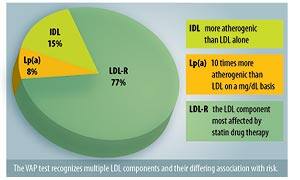
The VAP test also measures some blood lipids that the current lipid profile ignores, such as very low-density lipoprotein (VLDL); intermediate-density lipoprotein (IDL); and lipoprotein(a) [Lp(a)]. Atherotech researchers say measuring these additional lipid classes and subclasses can reveal more information concerning the risk of developing heart disease, which the traditional test might miss.
What the VAP Test Measures
- Total VLDL: Elevated VLDL levels correspond to an increased risk of heart disease and diabetes.
- Sum Total Cholesterol: The sum of HDL, LDL and VLDL levels.
- Total non-HDL: The sum of only LDL and VLDL levels; a higher value indicates a greater risk for developing heart disease.
- Total apoB100: Apolipoprotein B100 helps create, carry and deliver "bad cholesterol" to cells; measuring apoB100 levels aids in determining the type and/or cause of high cholesterol.
- Lp(a) cholesterol: Research suggests that Lp(a), which is similar to LDL, is an inherited risk factor for atherosclerosis.
- IDL: A lipoprotein of intermediate density; according to Atherotech, this number is elevated among individuals with a family history of diabetes.
- LDL-RC: LDL that is bound to C-reactive protein; this type of LDL is found at the site of atherosclerotic plaques in the body, which are one of the key features of artery disease and – when they rupture – the primary initiator of heart attacks.
- Sum Total LDL-C: The sum of Lp(a), IDL and LDL.
- LDL Size Pattern: Reported as one of three categories – A, A/B or B. In pattern A, the LDL molecules are larger and less dense, making them easier for the body to remove. In pattern A/B, there is a combination of light and dense molecules. In pattern B, smaller, high-density molecules predominate. According to Atherotech, patients with small, dense LDL particles (pattern B) have a four-fold greater risk of developing heart disease than patients with LDL size pattern A.
- HDL-2: A subclass of "good cholesterol" that is particularly protective against heart disease. A low number here could mean an increased risk of coronary artery disease, even in those with otherwise normal cholesterol levels.
- HDL-3: Another subclass of HDL, which does not protect against coronary artery disease to the same degree as HDL-2.
- VLDL-3: A triglyceride-rich very low-density lipoprotein; some studies suggest a potential correlation between higher VLDL-3 numbers and the development of diabetes.
Also, the VAP test provides individuals with a better idea of their vulnerability to the metabolic syndrome, a combination of factors that significantly elevate the risk an individual will develop diabetes or cardiovascular disease.
Cholesterol treatment goal guidelines from the ADA/ACC 2008 Consensus Statement include targets for LDL-C, non-HDL-C and APOB, which are included in the VAP but are not part of basic cholesterol tests.
VAP test
Although standard blood cholesterol tests (measuring total cholesterol, LDL, HDL, and triglycerides) have helped doctors to accurately assess heart disease risk in many patients, recent advances in medical science have demonstrated that conventional cholesterol testing provides only limited insight into the multiple factors that underlie cardiovascular disease. In fact, these tests identify only 40% of those at risk for coronary heart disease.
The good news is, scientists have developed a more advanced blood test that can far more accurately gauge your risk of heart disease. The Vertical Auto Profile (VAP) test augments the standard cholesterol profile with additional measurements that can identify the risk of cardiovascular disease.
Best of all, the VAP test not only offers a comprehensive assessment of cardiovascular risk, but also supplies vital information that can help you and your doctor formulate a customized disease-prevention program and measure its progress over time. This powerful diagnostic tool can help you take the steps necessary to avoid preventable health catastrophes—like heart attack and stroke—today.
The baby-boom generation understands that as they age, their risk for heart attacks, strokes, and other cardiovascular events continues to increase.1 Not content to succumb to disease and disability, this population is embracing a proactive, preventive approach to health care that includes advanced techniques of risk assessment such as the Vertical Auto Profile (VAP) cholesterol test.
Awareness of the VAP test is important for anyone who wants to stop cardiovascular disease in its tracks, even before signs and symptoms manifest. The VAP test is performed just like a traditional cholesterol panel: a technician or nurse draws blood and submits it to a laboratory. At reasonable cost, the VAP test provides more information than routine cholesterol tests and expands on this data. The comprehensive information derived from the VAP test enables physicians to more accurately predict their patients’ risk of heart disease, and to customize more aggressive, patient-specific treatment plans.
Even if your doctor’s office does not yet regularly utilize the VAP test, it is very likely that your physician will recognize the value of this advanced cholesterol screening tool, and will use the more detailed information it provides to devise the best treatment program to reduce your cardiovascular risk.
 |
How the VAP Test Works
Routine cholesterol tests provide only the four following measurements:
- Total cholesterol
- Triglycerides
- Low-density lipoprotein (LDL, the “detrimental’ lipid), determined by a mathematical calculation, not by direct measurement
- High-density lipoprotein (HDL, the “beneficial” lipid).
The standard lipid panel above is what physicians have relied on for years to assess their patients’ risk of cardiovascular disease. It has been a successful tool, helping physicians to lower patient cholesterol levels using a variety of medical therapies, including statin drugs, and motivating people to make lifesaving changes in their diet and lifestyle.
However, there are serious limitations to relying solely on the standard cholesterol panel. Most important, it can identify only about 40% of patients at risk for coronary heart disease.2 The truth is, many risk factors are involved in the development of heart disease, and for some people, high cholesterol may or may not be one of them. The well-known Framingham Study illustrated that the higher the cholesterol, the higher the statistical risk of a heart attack.3 Nonetheless, a frightening number of heart attacks still occur every day in people whose cholesterol values are seemingly normal. In fact, the American Heart Association reports that 50% of men and 64% of women who died suddenly of coronary heart disease had no previous symptoms!1
Heart disease can lurk silently within, hidden and unsuspected. However, the additional information provided by the VAP test can help identify at-risk patients more accurately than routine cholesterol tests.2
The expanded information from the VAP test includes:
- More accurate, direct measurement of LDL.
- Measurement of LDL pattern density. This is important because small, dense LDL (“Pattern B”) triples the likelihood of developing coronary plaque and suffering a heart attack.4
- Measurement of lipoprotein subclasses, which include HDL2 and HDL3, intermediate-density lipoprotein (IDL), very-low-density lipoproteins (VLDL1, VLDL2, VLDL3), and lipoprotein(a) [Lp(a)], a particularly dangerous lipoprotein that can lead to heart attacks and strokes.
Patients who test “normal” in a routine cholesterol panel often are found to be at risk for heart disease after taking the VAP test. This is crucially important, not only to diagnose a number of lipid disorders and optimize the choice of medications, but also for tracking improvement when patients are working to reduce their numbers, whether with drugs or lifestyle changes. Clearly, more information means more effective treatment, and thus better health outcomes.
In addition, VAP is the only cholesterol profile that tests for all the present and emerging risk factors identified in the National Cholesterol Education Program Adult Treatment Panel III (NCEP ATP III) cholesterol guidelines.5
 |
Prevention Is Key to Cardiovascular Health
I have performed a VAP test for the first time on many patients who have already had heart attacks or strokes, or who have undergone heart procedures such as bypass surgery or placement of a coronary stent. The results have often led me to think that if a VAP test had been performed earlier, maybe the heart attack or stroke could have been prevented, or the surgery would not have been necessary.
Too often in the United States, medical care is reactionary. A heart attack or stroke occurs, the sufferer rushes to the emergency room, and then doctors desperately try to rise to the rescue. All the physicians and patients I know appreciate that this is not the best approach. Part of the beauty of the VAP test is that it can help reduce the likelihood of this scenario occurring. Identifying risks for cardiovascular disease—and then working to correct them in order to prevent heart and vascular disease—is a better choice than costly surgical interventions.
Baby boomers, who have taken more hands-on responsibility for their health than any previous generation, can be even more strongly motivated to adopt wellness strategies when they better understand the specific risks facing them. It is one thing to tell patients that their cholesterol is high and they need to reduce it by changing their diet and lifestyle or by taking medication. It is something else to tell them that they can decrease their risk of heart attacks and emergency room visits by implementing strategies to adjust their cholesterol particles. The more definitively a health threat can be identified, the greater the patients’ compliance with treatment will be.
Since the National Cholesterol Education Program recommends people begin regular cholesterol testing at age 20, young adults can take a VAP test to learn about their cardiovascular disease risk early in life. This will allow them to take aggressive steps now—including diet and exercise—to maintain a healthy heart for life. Taking a VAP test now makes infinitely more sense than waiting until a cardiovascular catastrophe occurs, and then wondering if the event might have been prevented if a more complete cholesterol profile had been obtained earlier.
VAP CHOLESTEROL TESTING: WHAT YOU NEED TO KNOW | |
|

Should Everyone Take the VAP Test?
This question is still being debated in the medical community. It is more expensive than routine cholesterol panels, but it provides more information. It is simply the best way for physicians to learn more about their patients and identify heart disease risk earlier. As time goes by, more physicians are recognizing the limitations of conventional lipid assessment and turning to advanced lipoprotein testing for better answers.
Certainly anyone who has reason to believe he or she may be at high risk for cardiovascular disease—because of family history, previously diagnosed coronary or vascular disease, or factors such as high blood pressure, diabetes, obesity, any measure of coronary plaque, or identified abnormalities in cholesterol or triglycerides6—should strongly consider VAP testing. Even if you are simply concerned about heart disease, you can proactively encourage your doctor to perform this advanced test. It is now widely available in diagnostic laboratories around the country.
Being proactive means being eager to learn about ways to improve your health, and working with your doctor to create a personalized prevention and treatment plan. However, when it comes to tests that involve risk—such as imaging procedures that deliver radiation—I caution you to be wary. Sometimes, being proactive can lead you down that slippery slope to unnecessary surgical intervention. Fortunately, the VAP test has the distinct advantage of providing added information without added risk.
Subscribe to:
Posts (Atom)