Showing posts with label Dementia. Show all posts

Exercise, exercise, exercise to put off dementia

Staying active in later life could protect against dementia, as frail older people more than triple their risk of the disease.
Frail people struggle to do simple tasks such as walking 100 yards, putting on their shoes or getting out of bed.
A study has found people classed as frail in middle and old age are 3.5 times more likely to be diagnosed with Alzheimer’s disease or dementia a decade later.
This may come from insulin resistance, which makes people frail by speeding up the natural loss of muscle mass which happens in older age.
People with muscle weakness are more likely to have high blood sugar levels, caused by their resistance to insulin, which is also a cause of dementia.
Frail people also suffer from inflammation, which is a reaction of the immune system believed to lead to the brain changes seen in dementia.


Researchers at University College London analysed data on 8,700 English people aged 50 or over to determine their frailty. This included mobility problems, physical disability and poor general health, as well as chronic problems like cardiovascular disease.
They found people who were ‘pre-frail’, ticking almost enough boxes to fall into the category, were almost twice as likely to get dementia in the next 10 years.
The study’s lead author, Dr Nina Rogers from UCL, said: ‘Dementia is very difficult to manage, so the best thing we can do is to find ways to delay its onset and to slow its progress.
‘We know that there are simple things you can do to reduce the risk of frailty, like doing lots of physical exercise, so those are the things to focus on because the knock-on effect might lead to a reduction in the risk of developing dementia.’
Frail people are already at greater risk of going rapidly downhill following minor falls or health problems.
What is good for the heart is good for the head 
The study identified this group using 43 criteria, including mobility problems such as being unable to get up from a chair after a long period, to walk 100 yards or extend the arms above shoulder height.
The criteria also included disability measures like problems eating pr putting on shoes, depression and self-reported conditions including high blood pressure and heart failure.
It is well known that ‘what is good for the heart is good for the head’, so that people whose unhealthy lifestyles have led to heart problems may also raise their risk of brain disease.
Those who ticked more than a quarter of the boxes were found, after a decade of being monitored, to be 3.5 times more likely to be diagnosed with dementia.
‘Pre-frail’ people, with almost double the risk of dementia, ticked eight to 25 per cent of the boxes.

Read more

Lifestyle changes and dementia risk

"Nine lifestyle changes can reduce dementia risk," BBC News reports. A major review by The Lancet has identified nine potentially modifiable risk factors linked to dementia.
The risk factors were:
  • low levels of education
  • midlife hearing loss
  • physical inactivity
  • high blood pressure (hypertension)
  • type 2 diabetes
  • obesity
  • smoking
  • depression
  • social isolation
However, it's important to note that even if you add up the percentage risk of all of these factors, they only account for about 35% of the overall risk of getting dementia. This means about 65% of the risk is still due to factors you can't control, such as ageing and family history.
Although not guaranteed to prevent dementia, acting on the risk factors above should improve your physical and mental wellbeing.

What is dementia?

Dementia refers to a group of symptoms associated with the gradual decline of the brain and its abilities. Symptoms include problems with memory loss, language and thinking speed.
The most common cause of dementia is Alzheimer's disease. Vascular dementia is the next most common, followed by dementia with Lewy bodies.
For more information, visit the NHS Choices Dementia Guide.

Where did the review come from?

This review was written by the Lancet Commission on Dementia Prevention, Intervention and Care (LCDPIC). The commission is established by convening experts in the field to consolidate current and emerging evidence on preventing and managing dementia. It generates evidence-based recommendations on how to address risk factors and dementia symptoms. These are presented in this review.
The LCDPIC endeavoured to use the best possible evidence to make the recommendations. However, in cases where the evidence was incomplete, it summarised the balance of the evidence, drawing attention to the strengths and limitations.
The media in general has covered the review responsibly and accurately, with helpful comments from experts in the field.

What does the review say?

The review examines aspects of how better to manage the burden of dementia: the risk factors, interventions for prevention and interventions for treatment.

Risk factors

The LCDPIC discusses the effects of several different risk factors potentially linked to dementia.
The review reported population attributable fractions (PAFs). PAFs are an estimate of the proportion of cases of a certain outcome (in this case, dementia) that could be avoided if exposure to specific risk factors were eliminated – for example, how many lung cancer cases would be prevented if nobody smoked.
Using the available evidence, researchers calculated PAFs for the following risk factors.

Education

Less time in education – specifically, no secondary school education – was responsible for 7.5% of the risk of developing dementia.

Hearing loss

The relationship between hearing loss and the onset of dementia is fairly new. It's thought that hearing loss may add stress to an already vulnerable brain with regard to the changes that occur. Hearing loss may also increase feelings of social isolation. However, it's also possible that old age could have a role to play in this association.
The LCDPIC analysis found that hearing loss could be responsible for 9.1% of the risk of developing dementia.

Exercise and physical activity

A lack of physical activity was shown to be responsible for 2.6% of the risk of dementia onset. Older adults who do not exercise are less likely to maintain higher levels of cognition than those who do engage in physical activity.

Hypertension, type 2 diabetes and obesity

These three risk factors are somewhat interlinked; however, all had PAFs lower than 5%, with hypertension contributing the greatest risk of the three:
  • hypertension – 2%
  • type 2 diabetes – 1.2%
  • obesity – 0.8%

Smoking

Smoking was found to contribute to 5.5% of the risk of dementia onset. This is a combination of smoking being more widespread in older generations, and there being a link between smoking and cardiovascular conditions.

Depression

It's possible that depressive symptoms increase dementia risk due to their effect on stress hormones and hippocampal volume. However, it's not clear whether depression is a cause or a symptom of dementia. It was found to be responsible for 4% of the risk of developing dementia.

Lack of social contact

Social isolation is increasingly thought to be a risk factor for dementia as it also increases the risk of hypertension, heart conditions and depression. However, as with depression, it remains unclear whether social isolation is a result of the development of dementia.
It was found to contribute to 2.3% of the risk of developing dementia.

Prevention of dementia

The review highlights that although there are potentially modifiable risk factors for dementia, this does not mean dementia as a condition is preventable or easy to treat. It is evident that there are multiple risk factors contributing to the onset of the disease. However, some interventions that could prevent onset include:
  • Using antihypertensive drugs, such as ACE inhibitors, in people with hypertension.
  • Encouraging people to switch to a Mediterranean diet, which is largely based on vegetables, fruit, nuts, beans, cereal grains, olive oil and fish. This has been proven to improve cardiovascular health, and may help with the symptoms of type 2 diabetes, obesity and hypertension.
  • Encouraging people to meet the recommended physical activity levels for adults. Again, regular exercise may help with the symptoms of type 2 diabetes, obesity and hypertension.
  • Using cognitive interventions, such as cognitive training, which involves a series of tests and tasks to improve memory, attention and reasoning skills. The review points out, however, that the clinical effectiveness of most commercially available brain-training tools and apps is unproven.
  • Encouraging people to become more socially active. This could be by organising social activities – book clubs, for example – for older adults. 
  • Continuing to provide support to smokers who want to quit.
Read more about ways to reduce your dementia risk.

Even moderate drinking causes harm

MODERATE ALCOHOL CONSUMPTION can damage a person’s brain, researchers have claimed.
Researchers from the University of Oxford and University College London monitored the alcohol intake and cognitive performance of 550 men and women in the UK for over 30 years, from 1985 to 2015.
The research, published in the British Medical Journal, notes that none of the participants were “alcohol dependent”. Their mean age was 43 years and 23 people were excluded from the results because of poor data or others issues.
At the end of the study, researchers conducted MRI scans of the participants’ brains.
After taking into account factors such as age, gender and social activity, researchers found that people who drank more often had a shrunken hippocampus – which is thought to be the centre of emotion, memory and the autonomic nervous system.
While those consuming over 30 units a week were at the highest risk compared with people who didn’t drink, even those drinking moderately (14-21 units/week) had three times the odds of the right side of their hippocampus being affected.
The research found there was no protective effect of light drinking (1-<7 units/week) over abstinence. Higher alcohol use was also associated with faster decline in lexical fluency (vocabulary). No association was found with word recall.
Guidelines 
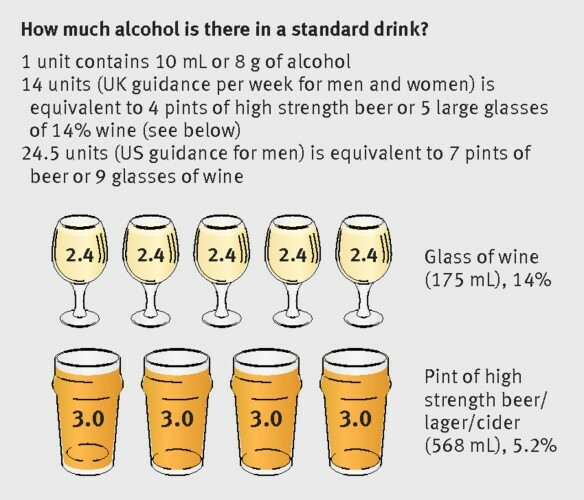
In Ireland, the weekly alcohol consumption guidelines are up to 11 standard drinks in a week for women and up to 17 standard drinks in a week for men.
A standard drink (also called a unit) here has about 10 grams of pure alcohol in it. In the UK, a standard drink has about eight grams of pure alcohol.
F1.large (1)Source: BMJ
In the study, researchers note that the following was already known about this topic:
  • Heavy drinking is associated with Korsakoff’s syndrome (a chronic memory disorder), dementia, and widespread brain atrophy (a loss of neurons)
  • While smaller amounts of alcohol have been linked to protection against cognitive impairment, few studies have examined the effects of moderate alcohol consumption on the brain
  • Previous studies have methodological limitations and have provided conflicting findings
They state that the new research finds:
  • Compared with abstinence, moderate alcohol intake is associated with increased risk of adverse brain outcomes and steeper cognitive decline
  • The hippocampus is particularly vulnerable, which has not been previously linked negatively with moderate alcohol use
  • No protective effect was found for drinking small amounts of alcohol over abstinence, in contrast to previous reports
In the paper, the authors state: “Our findings support the recent reduction in UK safe limits and call into question the current US guidelines, which suggest that up to 24.5 units a week is safe for men, as we found increased odds of hippocampal atrophy at just 14-21 units a week, and we found no support for a protective effect of light consumption on brain structure.
“Alcohol might represent a modifiable risk factor for cognitive impairment, and primary prevention interventions targeted to later life could be too late.”

Read more

What are some ways to avoid getting Alzheimer’s?

Here are the fundamental keys for reducing your risk of getting Alzheimer’s disease, a disease for which there is no treatment.

First, dramatically reduce your carbohydrate consumption while increasing your consumption of “good” fats like fish, nuts, seeds, and olive oil.

Second, get 15-20 minutes of aerobic exercise each day. This actually turns on the DNA in your genome that codes for the production of BDNF, basically the brain’s “growth hormone.”

Third, make sure you’re consuming at least 1000mg daily of the omega-3 DHA. Research clearly links higher DHA levels with reduced risk, not only for Alzheimer’s disease, but for other forms of dementia as well.


Read more

Exercise interventions for cognitive function in adults older than 50: a systematic review with meta-analysis

Publication

British Journal of Sports Medicine

Author(s)

Joseph Michael Northey, Nicolas Cherbuin, Kate Louise Pumpa, Disa Jane Smee, Ben Rattray

Abstract

Background
Physical exercise is seen as a promising intervention to prevent or delay cognitive decline in individuals aged 50 years and older, yet the evidence from reviews is not conclusive.

Objectives

To determine if physical exercise is effective in improving cognitive function in this population.

Design

Systematic review with multilevel meta-analysis.

Data sources
Electronic databases Medline (PubMed), EMBASE (Scopus), PsychINFO and CENTRAL (Cochrane) from inception to November 2016.
Eligibility criteria
Randomised controlled trials of physical exercise interventions in community-dwelling adults older than 50 years, with an outcome measure of cognitive function.
Results
The search returned 12 820 records, of
which 39 studies were included in the systematic
review. Analysis of 333 dependent effect sizes from 36 studies showed that physical exercise improved cognitive function (0.29; 95% CI 0.17 to 0.41; p less than 0.01). Interventions of aerobic exercise, resistance training, multicomponent training and tai chi, all had significant point estimates. When exercise prescription was examined, a duration of 45–60 min per session and at least moderate intensity, were associated with benefits to cognition. The results of the meta-analysis were consistent and independent of the cognitive domain tested or the cognitive status of the participants.

Conclusions

Physical exercise improved cognitive function in the over 50s, regardless of the cognitive status of participants. To improve cognitive function,
this meta-analysis provides clinicians with evidence to recommend that patients obtain both aerobic and resistance exercise of at least moderate intensity on as many days of the week as feasible, in line with current exercise guidelines.


Date

March 12, 2017

Read more

Dementia and statins

The take-home message of this entire body of research indicates that there is zero advantage of taking statin drugs if you are over the age of 65. The whole purpose of statins is to reduce the risk of heart attacks and strokes, and the only reason statins help is because of the drug’s mild-inflammatory effect. 

Unfortunately, statins decrease the production of CoQ10 which is the #1 most important nutrient when it comes to the integrity of the vascular system. 

Talk to your doctor about getting off statins and reducing inflammation the natural way. Deane Alban of the incredible team at Be Brain Fit writes: “Chronic inflammation is largely caused by unhealthy lifestyle habits such as eating poorly, lack of sleep, lack of exercise, stress, poor digestive health, and exposure to toxins. Anything that leads to free radical formation causes inflammation, too. Inflammation is not an all-or-nothing response, but a continuum. You won’t be able to get rid of all inflammation nor do you need to, but you do want to minimize its presence once it’s turning against your body.” 

To read Be Brain Fit‘s full list of tips on how to reduce inflammation you can visit BeBrainFit.com

Another tip worth noting is that chronic vitamin B deficiency has been found to be a major cause of dementia misdiagnosis. It has been proven that a boost in vitamin B can reverse these symptoms entirely.

Read more