Showing posts with label sugar. Show all posts

Evil triumphs over good?


Kellogg’s, the maker of Coco Pops, has beaten a junk food advert ban after lobbying to overturn a decision by the UK’s advertising regulator, in a move that has outraged obesity campaigners.
In August, the Advertising Standards Authority banned a Kellogg’s TV ad campaign for a Coco Pops granola product for breaking rules against advertising junk food to children.
However, the food manufacturer has managed to overturn the ban after lodging an appeal for an independent review of the decision, which is only accepted if it is established that there was a “substantial flaw” in the initial ruling.
“Following a lobbying effort from Kellogg’s, the ASA has rowed back from their original decision,” said Caroline Cerny of the Obesity Health Alliance, which lodged the original complaint with the ASA. “The original ruling closed a loophole preventing food companies from advertising to children by using characters and music associated with their unhealthy products.
“This is what happens when a large multinational food company uses its legal weight to fight rulings that influence their profits. Sadly, the price is the future health of our children. This is just another example of why we need strong government action to protect children from unhealthy food marketing, starting with a 9pm watershed on junk food adverts on TV.”
While the ASA deemed in the original ruling that the granola product itself was not junk food, it said that the wider content and context of the ad broke the UK advertising code and banned it.
The advert, they say, featured Kellogg’s famous Coco the monkey character and focused on making the cereal “chocolatey” – a hallmark of the wider Coco Pops range, which is deemed to be too sugary to market to children – and not enough on the product being advertised, healthier granola.
Under UK rules, children cannot be targeted with adverts for products that are high in fat, salt and sugar, and licensed characters should not be used to promote such products to them.
In its appeal, Kellogg’s argued that the ad did show the granola product as being clearly differentiated from the core Coco Pops range, and that rules the ASA enforces state that it is fine to use a brand character usually associated with a sugary food to promote a healthy one.
The company also pointed out that its original Coco Pops range has now been reformulated with a 40% reduction in sugar, which means that it is no longer officially classified as a junk food.
Kellogg’s argued that to rule that the ad for the granola product broke junk food rules “would be inconsistent with the government’s objectives on tackling unhealthy eating and discourage advertisers from developing healthier product alternatives”.
Following the independent review, the ASA has now cleared the ad of breaking any UK advertising rules.

The full article

Sugar

We’re rapidly becoming more aware of the dangers of what is now known as being overfat, and the main culprit is – you guessed it – sugar.
When did something nature deliberately put into apples, pears and bananas become a deadly source of ill-health? The answer lies not in the little sucrose molecule itself, but in the sheer quantity of sucrose and the newer, closely-related chemical variants, that endlessly tickle our taste buds. 
Humans have an exquisitely complex ability to distinguish sweetness. Our tongues are coated with thousands of taste receptors dedicated to the task, and they can detect subtle variations between a range of closely related chemical compounds.
The problem with sugar lies in its abundance and its cheapness. For the food industry this means sugar is a logical “secret” ingredient. Without sugar, many foods, from hamburger buns to the liberally applied ketchup, would taste very different. Some foods might even be unpalatable. The mantra of food manufacturers has become: If it doesn’t taste good, add sugar! If it’s not selling well, add sugar! If you want kids demanding it, add sugar! If you want consumers to crave it, add sugar!
As if sugar (sucrose) wasn’t cheap and abundant enough, by chemically modifying corn starch, an even sweeter (and cheaper) form of sugar known as high-fructose corn syrup was created in the 1950s. Thanks to its unique chemistry, and extra fructose (normally one half of a sucrose molecule), this concoction is even sweeter than sucrose. Variations of this fructose-laden chemical can be found in everything from pasta sauce to bread.
Evidence of the health damage excessive sucrose can cause, from hormonal disturbances to dental decay, mounts each year. Research also points to the hidden dangers of fructose, which behaves very differently in the body. Its metabolism in the liver appears to trigger oxidative damage that increases the risk of long-term liver damage and possibly cirrhosis.
So cutting sugar from your diet not only eliminates empty calories, but also potentially deadly chemical compounds. There is mounting pressure around the world for governments to introduce sugar taxes or limits on its advertising, but behind the scenes many food companies are quietly working on ways to trim sugar levels without affecting taste.
In the meantime, you’ll need to do the detective work yourself and identify where and how you can best eliminate excess sugar form your life. There are few scientific studies looking at the best way to cut sugar. You can either go “cold-turkey”, or you can adopt a gradual elimination plan. When it comes to your morning coffee, quitting sugar outright is the best way to change habits. Beyond that, you will need different strategies. But you’ll be amazed by how many things are just fine without any added sugar.
10 STEPS TO CUTTING YOUR SUGAR INTAKE
Watch those drinks
Most people would gag at the thought of swallowing nine teaspoons of sugar, some artificial flavoring and a cup and a half (375ml or 12 ounces) of carbonated water. But that’s what’s in a typical sugar-sweetened fizzy drink. Also, many drinks claiming to contain natural fruits, to be preservative-free or rich in vitamins and minerals pack the same sugar punch as major brand sugary drinks. Eradicate all sugary drinks from the fridge and cut out impulse convenience store purchases.
Fresh fruit and vegetables are always better
Isn’t fruit naturally rich in sugar? Yes, but when you consider the alternatives, there is far less sugar in whole fruit than just about all varieties of candies and sweets, as well as most supposedly healthy muesli snack bars. Fruit is nature’s ready-made snack.
Go easy on those pasta sauces
Many savoury tomato-based sauces, including ketchup, are jam-packed with sugar. It pays to look carefully at the label and find those that are lowest in added sugar. Better still, make your own. Simply mix canned or fresh tomatoes, some fresh herbs and simmer.
Same goes for salad dressings
Enjoying a healthy salad? Adding a splash of dressing? Think again. Supermarket salad dressings can be a hidden source of sugar, so maybe it’s time to try your own – a drizzle of Balsamic vinegar and extra virgin olive oil is a sensational dressing. Mix in some fresh herbs, try lemon juice or pomegranate vinegar for that extra pizazz.
Cultivate a natural yogurt habit
Stop and take a careful look at your yogurt tub. Most fruit yogurt is sweetened to the max. Cut to natural yogurt. Need a sweet rush? Add fruit!  
Desert the dessert
These are almost always sugar-laden. Spend a few moments looking at the label on your favorite ice cream – sugar, lots of sugar! A fresh fruit salad is a nice, natural alternative, but the main thing is moderation, so avoid desserts with every meal.
Bitter is better
Chocolate is a sweet indulgence that should remain an occasional one. If you must break into a fresh block, choose dark chocolate. What’s not cocoa/cacao is generally sugar, so the darker the better. And don’t forget to share.
Say when to pre-mixed alcoholic drinks
Ready-mixed spirits or spritzers often have the same levels of sugar as any other carbonated beverage. Check the sugar content of your favorite tonic too.
Find replacement taste sensations
There is a whole world of flavor to be enjoyed, so open your palate to the many intense, spicy, bitter, intriguing and wonderful tastes out there. Plus, adding spice such as turmeric, chilli, coriander, cumin or nutmeg not only adds taste, it can have health benefits too.
Remember, keep an eye out for sugar in disguise
There are dozens of different names for sugar listed on food labels. The more common names you’ll see are:  sucrose, high-fructose corn syrup, barley malt, coconut sugar, dextrose, maltose, rice syrup, and fruit juice concentrate. Very few foods actually label themselves low in sugar, so you will have to search for yourself. 

Sugar substitutes

1. Agave Nectar

History lesson time: The Aztecs used agave thousands of years ago and praised this syrup as a gift from gods. A derivative of the same plant as tequila (cheers!), this golden sweetener tastes similar to honey and is perfect in hot or iced tea. But be sure to use in moderation—agave's high fructose content can sometimes cross it in to the dangerfood zone!

2. Maple Syrup

The benefits of maple syrup are aplenty: It comes directly from a plant’s sap and contains over 50 antioxidants. Make sure to grab the real stuff (sorry, Aunt Jemima) and spread it over waffles or use it in homemade granola


How much sugar.....

As for sugar? We don't have dessert every day—and when we do, we try to make it healthy—so we can't be eating toomuch of it, right?
Wrong. When we tallied up the amount of sugar in a day's worth of relatively healthy meals and snacks (yogurt with fruit and granola, a whole-wheat turkey wrap, trail mix, and a homemade stir-fry), we were shocked. We even skipped dessert!
There's a lot of sugar hiding in everyday food (both added and natural sugars are included in the counts below). Check out the stats, get more info on the type of sugar you should try to avoid, and find ideas for healthy swaps.

Yogurt With Berries and Granola:*

6 ounces low-fat vanilla yogurt: 29 grams of sugar
1 cup mixed berries: 8.5 grams
1/2 cup granola: 12 grams

Coffee Cake and Coffee With Almond Milk:

1/2 slice coffee cake: 17 grams
1 cup coffee: 0 grams
1/2 cup almond milk: 3.5 grams
Turkey Wrap:
4 ounces honey-roasted turkey: 4 grams
1 whole-wheat tortilla wrap: 2 grams
2 teaspoons honey mustard: 4 grams
Handful of lettuce: 0.5 grams
1/2 avocado: 4 grams

Trail Mix:

6 tablespoons (about 1/3 cup) nuts, raisins, chocolate chips: 22 grams

Pineapple Sweet and Sour Chicken:

3 ounces skinless chicken breast: 0 grams
3 tablespoons bottled sweet and sour sauce: 18 grams
1/2 cup egg noodles: 0 grams
1/2 cup canned pineapple chunks: 15 grams 
1/3 tablespoon vegetable oil: 0 grams
1 tablespoon soy sauce: 0 grams
1/3 cup red bell pepper: 2 grams

Grand Total: 141.5 grams of sugar

Whoa. The other surprise? All of this food adds up to just under 2,000 calories, which is completely fine for men and women—maybe even on the low end, depending on activity levels, says Elisa Zied, R.D.N., nutritionist and author of Younger Next Week.

So How Much Sugar Is Too Much?

Less than you may think. The current Dietary Guidelines for Americans suggests limiting added sugar to less than 10 percent of calorie intake. If you eat 2,000 calories per day, your goal is to eat less than 200 calories (50 grams) of added sugar.
The American Heart Association is even stricter: It recommends women consume no more than 100 calories (24 grams) of added sugar per day; men, no more than 150 calories (36 grams). Yep, the breakfast and mid-morning snack above already surpass these recommendations.

Added Vs. Natural Sugars

Notice how we keep talking about added sugar. That's the kind you really want to cut down, Zied says—not the naturally occurring sugar in fruit or dairy. The yogurt, for example, has about 12 grams of natural sugar and 17 grams of added sugar in a six-ounce container. (Since labels don't discriminate between the two kinds, you'll have to do some digging online to find this info.)
So let's revisit breakfast. Leaving out the 8.5 grams of natural sugar from the fruit and the 12 grams from the yogurt brings down the total amount of added sugar in the breakfast to 29 grams. Still a lot.
And some more surprising news: There's not a big difference in the way your body treats sugar found naturally in fruit and sugar added to candy and cookies, at least from a chemical standpoint, says Rania Batayneh, M.P.H, nutritionist and author of The One One One Diet. "Both of these sugars are ultimately broken down into fructose and glucose, which are metabolized the same once they reach your gut," she says.
What does differ: how fast they’re broken down. "Because the sugar in fruits is paired with fiber and water, it’s released much more slowly into your body, providing you with a consistent stream of energy," Batayneh says. "Added sugar, without fiber and water, is broken down immediately, leading to a surge in insulin and blood sugar levels. As a result, you don’t feel full at all—you just crave more sugar."

What Else Is So Bad About Sugar?

Maybe a better question would be what isn'tSugar has been shownto increase your risk of type 2 diabetes, metabolic syndrome, obesity, and cardiovascular disease. Cutting back on sugar may lead to tons of benefits for your body, including lower blood pressure, reduced risk of cancer, a sharper brain, clearer skin, and fewer cravings.
Another downside of eating too much added sugar? It takes the place of calories in foods that provide lots of nutrients, Zied says. Plus, many sugary foods and beverages are easy to overdo (think of cookies, candy, soda, or even condiments like ketchup).

Smarter Swaps

Breakfast:

When it comes to yogurt, go Greek, Batayneh says. She likes Chobani's Simply 100 Vanilla Greek Yogurt, which contains 100 calories, 7 grams of sugar, and 12 grams of protein. She also suggests limiting granola to a quarter cup to cut back on sugar. Or swap it completely for chopped nuts like almonds or walnuts, Zied says.

Mid-Morning Snack:

Why do pastries and cookies always seem to appear at work just when we get hangry before lunch? Indulging in one of these high-sugar foods can lead to additional cravings, Batayneh says. "Without protein, you set yourself up for a blood sugar roller coaster," she says.
If you really want a bite, go ahead and #treatyoself once per day, keeping the portion small. "Choose the treats that you really enjoy and skip the ones that you’re eating simply because they’re there," Batayneh adds.
Zied also suggests keeping nutrient-rich foods on hand for snacking at the office. (Need inspiration? Here are 42 healthy and portable snacks.)

Lunch:

A turkey wrap for lunch looks pretty good, according to the experts. One tweak for even more nutrition: "Adding a side salad or raw veggies like carrots and snap peas can bump up the antioxidant, vitamin, and fiber count, without adding sugar or fat," Batayneh says. "Plus, their bulk will make you feel more satisfied."

Mid-Afternoon Snack:

It's easy to go way past the recommended quarter-cup portion of trail mix, Batayneh says. A better choice: a KIND Dark Chocolate Nuts and Sea Salt Bar. "At 200 calories and five grams of sugar, this snack will satisfy your sweet tooth without going overboard—it's really like portion-controlled trail mix," she says.

Dinner:

As long as you're not relying on delivery, a homemade dish like stir-fry isn't too bad. Still, something like chicken with steamed broccoli and sweet and sour sauce on the side will give you all the flavor, while keeping sugar to a minimum, Zied says. (Or try one of these quick and easy stir-fry recipes that are even better than takeout.)

The Takeaway

Yes, most of us eat way too much sugar—no matter how virtuous we think we are. And science has made it clear that added sugar is doing some serious damage to our bodies. Being aware of our choices throughout the day (try keeping a food diary) is a good place to start.
While it can be tough to cut sugar in the beginning (it's addictive, after all), Zied reminds us that the less sugary food you eat, the less sugary food you want. The bottom line? "Choose only the sugary foods you love most," Zied says. "And enjoy them in small portions."

Triglyceride spikes

Holiday indulgences can result in more than gaining a few extra pounds. Fatty sweet cookies, pies, and candy as well as excess calories and alcohol can lead to a spike in your triglycerides. Why should this concern you? It may be putting you at risk for heart disease.
Lorraine Matthews-Antosiewicz, registered dietitianand author of 10 Days to Sugar Free: Sugar Detox Survival Guide, has provided answers to some questions regarding the relationship between triglycerides, fat, and sugar.   Read on to learn what steps you can take to lower triglycerides and reduce heart disease risk.
What are triglycerides?
Triglycerides are a type of fat that come from food, and your body also makes them.  They are the most common type of fat found in the body.  Triglycerides are continually circulating in the blood ready to be metabolized to provide a source of energy when needed, but their main function is to store energy for later use.   When you consume more calories than your body can use, it converts the excess into triglyceride and stores it in fat cells.  Fat cells hold the triglyceride molecules until your body needs energy between meals.  Hormones signal the fat cells to release the triglycerides for your body to use.
Why do triglycerides matter?
When present in excess, triglycerides can be stored as fat which may lead to obesity and related health conditions over time.  Research suggests that high levels of triglycerides in the blood may increase the risk of developing coronary artery disease, diabetes, and fatty liver disease.  According to the American Heart Association, young people with high triglyceride levels have a four times greater risk of developing heart disease or having a stroke than young people with normal triglyceride levels.
How are triglycerides measured?
Triglyceride levels in the blood are measured by a simple blood test. Your doctor will usually check for high triglycerides as part of a routine cholesterol screening called a lipid panel or lipid profile. Fasting for nine to 12 hours is required before blood is drawn for an accurate triglyceride measurement.
What is considered a normal triglyceride level?
The American Heart Association guidelines for triglyceride levels are as follows:
  • healthy: below 100 milligrams per deciliter of blood (mg/dL)
  • borderline high: 150 to 199 mg/dL
  • high: 200 to 499 mg/dL
  • very high: 500 mg/dL and above.
What causes high triglycerides?
Some people have a genetic predisposition to manufacture excessive amounts of triglycerides.  Triglycerides can become elevated as a result of having diabetes, hypothyroidism, or kidney disease.  Being overweight and inactive can also contribute to abnormal triglycerides.  Dietary factors play a role as well.
How does diet affect triglycerides?
Eating too much of the wrong kinds of fats - saturated and trans fats - can raise your blood triglycerides. Triglyceride levels can also rise after drinking alcohol or eating foods that are high in carbohydrates especially sugary and refined carbs.  This includes sugar, honey, agave and other sweeteners, soda and other sugary drinks, candy, baked goods, and anything made with white (refined) flour including white bread, cereals, pastries, white pasta, and white rice.  Dried fruit and fruit juice contain high amounts of fructose which has a strong impact on raising triglyceride levels.
What is the recommended intake for sugar?
The American Heart Association recommends no more than 6 teaspoons per day (25 grams) of added sugar for adult women and 9 teaspoons (37.5 grams) for men.  While all individuals should limit sugar intake, it is especially important for those with increased triglyceride levels. Consumption of sugary   low-quality refined carbs causes a sudden rise in insulin, which may lead to a spike in triglycerides.
For further guidance, you can access Lorraine’s 10 Days to Sugar Free: Sugar Detox Survival Guide here.

Carbohydrates and sugars

Are all carbohydrates sugars? Are all sugars carbohydrates? What is a carbohydrate? And what is a sugar? This is not chemistry class, but I think we all need to know the answers to these basic questions if we are going to guard our health. So, I’ll try to keep it simple and interesting. After all, we all have to eat, and making wise choices requires us to be well informed. There’s a lot of misinformation going around so listen up.

All carbohydrates are saccharides. The word saccharide comes from the Greek word meaning sugar. Carbohydrates are divided into four types: monosaccharides, disaccharides, oligosaccharides, and polysaccharides. Monosaccharides and disaccharides are smaller compounds, composed of one or two molecules, and are commonly referred to as sugars. These compounds very often end in the suffix –ose. Examples include glucose (as in blood sugar), sucrose (as in table sugar), fructose (fruit sugar), and lactose (milk sugar).

Polysaccharides store energy (e.g. glycogen and starch) and as structural components (cellulose in plants). The term carbohydrate is often used to mean any food that is rich in complex carbohydrates such as cereals, bread, rice or pasta, or simple carbohydrates, such as candy, jams, jelly and ice cream.

Glucose, fructose and galactose are the three monosaccharides. They are the simplest carbohydrates in that they cannot be broken down into smaller molecules. They are the major source of fuel for metabolism, being used as an energy source (glucose being the most important). When not immediately needed for energy, they are converted into its storage form, glycogen, mainly in liver and muscle cells.

The disaccharides include sucrose (composed of one glucose and one fructose molecule), lactose (composed of one glucose and one galactose molecule) and maltose (two glucose molecules bonded in a special way). Oligosaccharides and polysaccharides are just longer chains of monosaccharides bound together. Oligosaccharides contain between three and ten monosaccharides and polysaccharides contain greater than ten monosaccharide units.

The human diet contains many foods high in carbohydrates: fruits, sweets, soft drinks, breads, pastas, beans, potatoes, rice and cereals. Carbohydrates are a common source of energy in living organisms; however, no carbohydrate is an essential nutrient in humans. Carbohydrates are not necessary building blocks of other molecules, and the body can obtain all its energy from protein and fats.

The brain and neurons generally cannot burn fat for energy, but use glucose or ketones. Humans can synthesize some glucose (in a process called gluconeogenesis) from specific amino acids, from the glycerol backbone in triglycerides, and in some cases from fatty acids. Glucose is a nearly universal, accessible and preferred source of calories. It is used first, either directly or indirectly from glycogen in storage. Polysaccharides are also a common source of energy. Many organisms can easily and quickly break down starches into glucose.

A commonly held belief among the general public, and even among nutritionists, is that complex carbohydrates (polysaccharides, e.g. starches) are digested more slowly than simple carbohydrates (sugars) and thus are healthier. However, there appears to be no significant difference between simple and complex carbohydrates in terms of their effect on blood sugar. Some simple carbohydrates (e.g. fructose) are digested very slowly (and very differently from glucose), while some complex carbohydrates (starches), especially that in processed food, raise blood sugar rapidly.

It is not sufficient, therefore, to buy foods that trumpet “whole grain ingredients.” The primary ingredients of these foods (those listed first) may be “bleached all purpose flour” (a highly processed food), sugar, dextrose, molasses, sucrose or HFCS (all highly processed sugars), before any “whole grains” are added. When you see grain sprinkled on the surface of that loaf of bread, just realize that it’s been brushed with HFCS to give it a nice brown color and make it sticky.

Always a wiser choice is to choose whole, unadulterated foods from the meat, dairy and produce aisles. Avoid the center of the store; shop the perimeter. Avoid food sold in a box or a bag, except perhaps flash frozen fish and veggies, in which case always check the ingredients list. Avoid anything refined or heavily processed. In other words, eat real food.

N.B.: For the record and for those who would doubt my authority of make some of the claims herein, this column has been largely cribbed – much of it lifted verbatim – from the Wikipedia entry “Carbohydrate.” Credit them. Check it out.

Read more

Sugar NOT so evil?

Gary Taubes paints a lively picture of lawmaker overzealousness, industry subterfuge, and researcher bias to argue that fat may have been unfairly blamed for the ravages of sugar, and as a result, misguided government dietary advice drove Americans to eat more sugar, ultimately contributing to obesity, diabetes, and coronary heart disease. Yet the key questions Taubes raises cannot be evaluated via historical narrative. It’s time to hang up our tweed blazers and slip into our white lab coats, because Taubes has made specific and testable assertions, which I will evaluate in three parts. First, I will examine the 1980 Dietary Guidelines to determine if they condemn fat and take a weak stance on sugar as suggested. Second, I will evaluate the hypothesis that the Guidelines contributed to obesity, diabetes, and coronary heart disease. And third, I will evaluate the hypothesis that sugar “may be the primary cause” of the three aforementioned conditions.

Inside the 1980 Dietary Guidelines for Americans
In the opening sentence of his essay, Taubes states that “forty years ago this month, January 1977, the federal government entered the business of giving dietary advice,” referring to a congressional report that gave rise to the 1980 Dietary Guidelines for Americans. In fact, the federal government has been issuing dietary advice regularly for over a century.[1] The 1980 Guidelines were, however, notable for the fact that they abandoned the traditional “eat more” approach of diversifying and balancing the diet, in favor of an “eat less” approach of limiting foods perceived as unhealthy.[2]
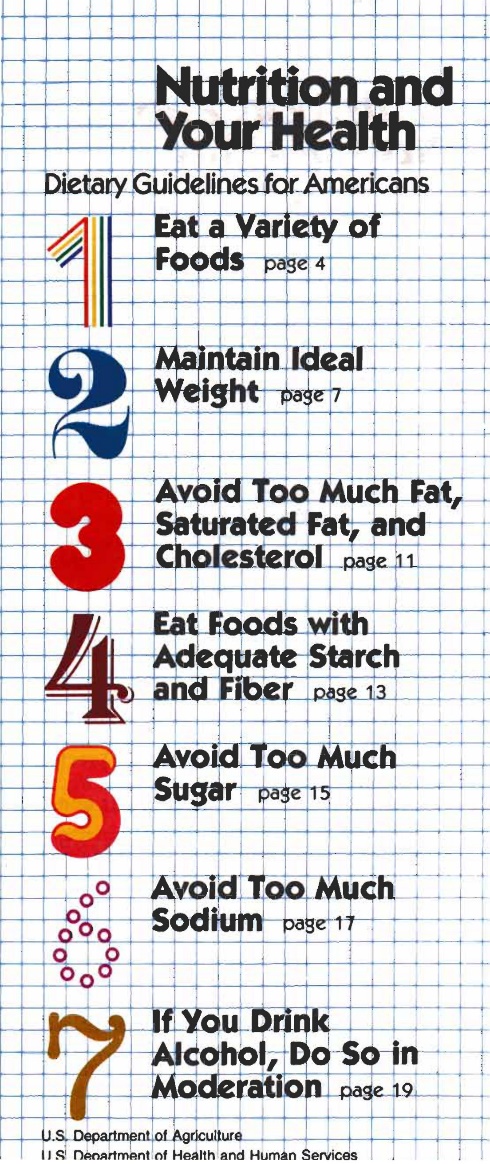
Taubes argues that this document condemned fat and took a weak stance on sugar. Let’s have a look for ourselves.[3] At the core of the 1980 Guidelines were seven pieces of dietary advice, shown below:
As you can see, “avoid too much fat” and “avoid too much sugar” are equally prominent and identically worded recommendations. Taubes suggests that the statement “avoid too much sugar” is vague and lacks conviction—it is “a tautological statement that could apply to any food.” Yet we are intended to believe that the same language applied to fat altered the course of the American diet.
The Guidelines went further, providing explicit guidance on how to “avoid too much sugar”:
  • Use less of all sugars, including white sugar, brown sugar, raw sugar, honey, and syrups.
  • Eat less of foods containing these sugars, such as candy, soft drinks, ice cream, cakes, cookies.
In the section titled “Maintain Ideal Weight,” the document lays out its four-part plan for weight loss: Increase physical activity, eat less fat and fatty foods, eat less sugar and sweets, and avoid too much alcohol. Again, the advice to limit fat and sugar intake receive equal attention, and the Guidelines clearly implicate excess sugar intake in obesity.
A person who faithfully adhered to the Guidelines would end up eating a diverse, largely unprocessed diet composed of whole grains, beans, nuts, lean meats, seafood, dairy, eggs, vegetables, and fruits, with little added sugar, added fat, or highly processed foods or beverages. Are we really to believe that this advice—which clearly and repeatedly recommended eating less sugar—made Americans eat more sugar, leading to obesity, diabetes, and coronary heart disease? Having reviewed the Guidelines, the notion strains credulity, but let’s test it anyway.

Wrath of the Guidelines
Taubes argues that the Guidelines may have unintentionally contributed to obesity, diabetes, and coronary heart disease. This rests on the assumption that the Guidelinesthemselves substantially influenced American eating behavior, either directly or indirectly via the food industry, and therefore that changes in the American diet over time can be attributed to it rather than to the numerous other shifts in the American food and cultural landscape that were happening at the time.[4] No evidence is presented to support this assumption, so we will examine it here.
If the Guidelines substantially influenced the American diet, then we should observe that total fat, added fat, and added sugar intake declined in its wake. In perfect contrast to this prediction, our total intake of fat remained approximately the same after the Guidelines, our intake of added fat increased, and our intake of added sugar increased.[5],[6]
Furthermore, we should observe a decline in the consumption of highly processed foods rich in fat and sugar that the Guidelines clearly advised against. To test this prediction, here are the top six sources of calories in the U.S. diet, in descending order of importance, as of 2006:
  1. Grain-based desserts (cakes, cookies, donuts, pies, and related items)
  2. Yeast breads
  3. Chicken and chicken-mixed dishes
  4. Soda, energy drinks, and sports drinks
  5. Pizza
  6. Alcoholic beverages[7]
This list is both disturbing and informative. Cake and related desserts are the number one source of calories in the American diet. Soda, pizza, and alcohol are three of the remaining five items. The average American diet is not even remotely inspired by the Guidelines.
The truth is that we don’t wash down our pizza and cake with beer and soda because we think it’s healthy or because we believe the government recommended it. We do it because we are human beings who are driven by considerations of pleasure, cost, and convenience—precisely the qualities the food industry has been optimizing for the last 40 years.[8]
Taubes assumes that we suffer from increasing rates of obesity and diabetes because we have failed to identify their true cause. Yet the evidence suggests a simpler and more compelling explanation: We eat too much food that is obviously unhealthy, and it’s not because researchers or the government told us to, but because we like it.

A Slow-Acting Toxin
According to Taubes, sugar may be a “toxin” and “the primary cause of diabetes, independent of its calories, and perhaps of obesity as well.” Elsewhere in the essay, coronary heart disease is added to the list. Yet Taubes asserts that this speculative hypothesis cannot currently be tested because there is so little existing research on sugar, and so little interest in conducting such research, that “the research necessary to nail it down would take years to decades to complete and is not even on the radar screen of the funding agencies.”
This belief is remarkable in light of the fact that a Google Scholar search returns hundreds of scientific papers on the health impacts of sugar, many of them human randomized controlled trials, and many funded by the U.S. National Institutes of Health. In reality, the health impacts of sugar are of considerable interest to the scientific community, and as such, they have been studied extensively. Having established that this research exists, let’s take a look at it.
The hypothesis that sugar is the primary cause of coronary heart disease is easily refuted. In the United States, coronary heart disease mortality has plummeted by more than 60 percent over the last half century, despite a 16 percent increase in added sugar intake.[9]Roughly half of this decline can be attributed to better medical care, while the other half is attributed to underlying drivers of disease such as lower cholesterol and blood pressure levels and an impressive drop in cigarette use.[10]This striking inverse relationship is incompatible with the hypothesis that sugar is the primary cause of coronary heart disease, although it doesn’t exonerate sugar.
Is sugar the primary cause of diabetes, “independent of its calories”? Research suggests that a high intake of refined sugar may increase diabetes risk, in large part via its ability to increase calorie intake and body fatness, but it is unlikely to be the primary cause.[11] An immense amount of research, including several large multi-year randomized controlled trials, demonstrates beyond reasonable doubt that the primary causes of common (type 2) diabetes are excess body fat, insufficient physical activity, and genetic susceptibility factors.[12]
The ultimate test of the hypothesis that sugar is the primary cause of obesity and diabetes would be to recruit a large number of people—perhaps even an entire country—and cut their sugar intake for a long time, ideally more than a decade. If the hypothesis is correct, rates of obesity and diabetes should start to decline, or at the very least stop increasing. Yet this experiment is far too ambitious to conduct.
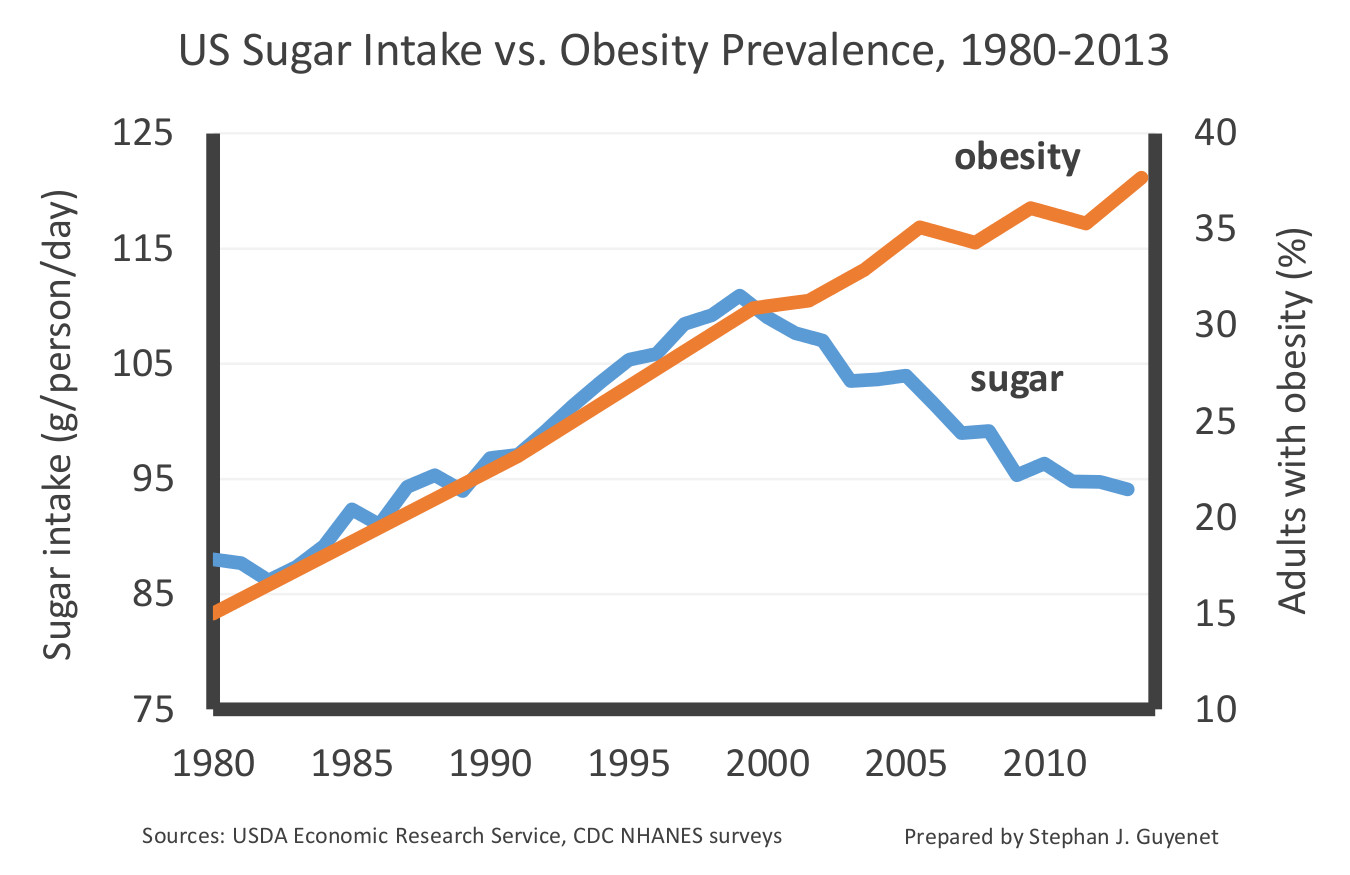
Or is it? In fact, this experiment has already been conducted—in our very own country. Between 1999 and 2013, intake of added sugar declined by 18 percent, taking us back to our 1987 level of intake. Total carbohydrate intake declined as well.[13] Over that same period of time, the prevalence of adult obesity surged from 31 percent to 38 percent, and the prevalence of diabetes also increased.[14]
U.S. sugar intake and adult obesity prevalence, 1980-2013. Data are from Centers for Disease Control and Prevention NHANES surveys and USDA Economic Research Service food disappearance records (5,6). Axes are bounded to illustrate correlation, or lack thereof.
Americans have been reining in our sugar intake for more than fourteen years, and not only has it failed to slim us down, it hasn’t even stopped us from gaining additional weight. This suggests that sugar is highly unlikely to be the primary cause of obesity or diabetes in the United States, although again it doesn’t exonerate sugar. Furthermore, it suggests that the laser-like focus on sugar is a distraction from the true, more complex nature of the problem.
I have presented a small piece of a large body of evidence that is more than sufficient to refute the assertion that sugar may be the primary cause of obesity, diabetes, and coronary heart disease. At the same time, this evidence does suggest that added sugar is part of a broader diet and lifestyle landscape that contributes to these three conditions, a conclusion that is not especially controversial within today’s scientific, medical, and public health communities.

Retraction...

Aseem Malhotra screws up again

Our old friend Aseem Malhotra is starting to become a regular at Retraction Watch. A year after sparking an investigation at the British Medical Journal, Malhotra found himself in hot water with the British Journal of Sports Medicine.

You almost certainly heard about Malhotra's article in the BJSM attacking the 'myth' that exercise helps people lose weight. This risible claim was broadcast around the world. What you probably did not hear is that the article was taken offline within 48 hours and only reappeared last week.

Why was it suspended? Any number of factual inaccuracies could have been responsible (see here for an example), but rumour had it that undisclosed conflicts of interest were the main reason. As I mentioned at the time, Malhotra's co-authors are neck deep in the low-carb/Atkins/banting diet and one of them has a book to sell. This is a fairly mild competing interest, but it is typical of a BMJpublication to be more concerned about an author receiving an indirect financial benefit than about his article being truthful.

The competing interest was not the only reason, however. The article has been subtly altered and the following notice has been added...

Correction notice This article has been amended from the original published on 29th April 2015. The body of the text was slightly edited and a reference removed. Competing interests have been added.

The edited part looked like this in the original...


It now looks like this...


As you can see, the journal has removed the part about the tobacco industry "buying the loyalty of bent scientists". This is important because the paragraph in question accuses the food industry of using "tactics chillingly similar to those of big tobacco."

And, in case anybody was in any doubt that Malhotra et al. are accusing the food industry of hiring 'bent scientists', reference 5 (which has now also been removed) was 'Sugar: spinning a web of influence' by Jonathan Gornall. I wrote about Gornall's article(which was published in the BMJ) a few months ago.

A theme is emerging in his hatchet jobs. First, he takes a policy which is controversial with the public but which has legitimate arguments for and against. He then treats the policy as a no-brainer which could only possibly be opposed by vested interests. He then looks for any kind of funding from business to civil society and the public sector; if he cannot find any he implies that it exists. Finally, he pads out his articles with quotes from activists and presents their failure to persuade government to bring in the controversial policy as being the result of 'webs of influence'.
Last year it was minimum pricing with the Alcohol Health Alliance. This time it's food reformulation with Action on Sugar.

Gornall's articles for the BMJ have all been of a very low quality and the journal embarrassed itself by publishing the sugar article, in particular. Gornall failed to understand that collaborations between the government and the food industry are not a dirty secret. On the contrary, they are the norm, and everybody who works in the field understands this.

The great and the good of 'public health' nutrition lined up in the Rapid Responses to attack the article. Prof Barry Popkin described it as "not only naïve but misguided" and said that Dr Susan Jebb, who bore the brunt of Gornall's poison pen, was "quite incorrectly impugned". The Chief Executive of the Medical Research Council said "please add my name to your 'tangled web'. It would be an honour to stand alongside scientists such as Susan Jebb, Ann Prentice and Ian Macdonald, who are committed to improving public health through research." It's worth reading the Rapid Responses in full.

This should have been enough for the BMJ to end its association with Gornall but I understand that he is currently carrying out more "research" for the journal. Even Gornall, however, did not describe Susan Jebb, Ian MacDonald et al. as "bent scientists". By using that phrase and citing Gornall's article as proof, Malhotra and his chums came very close to doing so. In the eyes of the libel lawyers, they may actually have done so, hence the retraction and correction.

Here we have two people—Malhotra and Gornall—who should not be allowed within a hundred miles of a medical journal publishing utter tripe, with one referencing the other. This Laurel and Hardy act would be quite amusing if it didn't push, and indeed exceed, the boundaries of what can be printed in a serious magazine. As I have shown time and again on this blog, Malhotra writes down the first thing that comes into his head. He is extremely credulous and not terribly bright. This is the second time in twelve months that he has got a journal into trouble, despite the fact that he rarely writes for journals. How many more chances is he going to be given? 

Read more