The gastrointestinal tract (GIT) of fish supports a dynamic microbial ecosystem that is intimately linked to host nutrient acquisition, epithelial development, immune system priming, and disease prevention, and we are far from understanding the complex interactions among parasites, symbiotic gut bacteria, and host fitness. Here, we analyzed the effects of environmental factors and parasitic burdens on the microbial composition and diversity within the GIT of the brown trout (Salmo trutta). We focused on the emerging dangerous salmonid myxozoan parasite Tetracapsuloides bryosalmonae, which causes proliferative kidney disease in salmonid fish, to demonstrate the potential role of GIT micobiomes in the modulation of host-parasite relationships. The microbial diversity in the GIT displayed clear clustering according to the river of origin, while considerable variation was also found among fish from the same river. Environmental variables such as oxygen concentration, water temperature, and river morphometry strongly associated with both the river microbial community and the GIT microbiome, supporting the role of the environment in microbial assemblage and the relative insignificance of the host genotype and gender. Contrary to expectations, the parasite load exhibited a significant positive relationship with the richness of the GIT microbiome. Many operational taxonomic units (OTUs; n = 202) are more abundant in T. bryosalmonae-infected fish, suggesting that brown trout with large parasite burdens are prone to lose their GIT microbiome homeostasis. The OTUs with the strongest increase in infected trout are mostly nonpathogenic aquatic, anaerobic sediment/sludge, or ruminant bacteria. Our results underscore the significance of the interactions among parasitic disease, abiotic factors, and the GIT microbiome in disease etiology.
IMPORTANCE Cohabiting microorganisms play diverse and important roles in the biology of multicellular hosts, but their diversity and interactions with abiotic and biotic factors remain largely unsurveyed. Nevertheless, it is becoming increasingly clear that many properties of host phenotypes reflect contributions from the associated microbiome. We focus on a question of how parasites, the host genetic background, and abiotic factors influence the microbiome in salmonid hosts by using a host-parasite model consisting of wild brown trout (Salmo trutta) and the myxozoan Tetracapsuloides bryosalmonae, which causes widely distributed proliferative kidney disease. We show that parasite infection increases the frequency of bacteria from the surrounding river water community, reflecting impaired homeostasis in the fish gut. Our results also demonstrate the importance of abiotic environmental factors and host size in the assemblage of the gut microbiome of fish and the relative insignificance of the host genotype and gender.
Read more
Showing posts with label Environment. Show all posts
Showing posts with label Environment. Show all posts

Diseases due to unhealthy environments: an updated estimate of the global burden of disease attributable to environmental determinants of health
The update of the global burden of disease attributable to the environment is presented. The study focuses on modifiable risks to show the potential health impact from environmental interventions.
Methods
Systematic literature reviews on 133 diseases and injuries were performed. Comparative risk assessments were complemented by more limited epidemiological estimates, expert opinion and information on disease transmission pathways. Population attributable fractions were used to calculate global deaths and global disease burden from environmental risks.
Results
Twenty-three percent (95% CI: 13–34%) of global deaths and 22% (95% CI: 13–32%) of global disability adjusted life years (DALYs) were attributable to environmental risks in 2012. Sixty-eight percent of deaths and 56% of DALYs could be estimated with comparative risk assessment methods. The global disease burden attributable to the environment is now dominated by noncommunicable diseases. Susceptible ages are children under five and adults between 50 and 75 years. Country level data are presented.
Conclusions
Nearly a quarter of global disease burden could be prevented by reducing environmental risks. This analysis confirms that eliminating hazards and reducing environmental risks will greatly benefit our health, will contribute to attaining the recently agreed Sustainable Development Goals and will systematically require intersectoral collaboration to be successful.
A quarter of ALL diseases....
16 JUNE 2006 | GENEVA - As much as 24% of global disease is caused by environmental exposures which can be averted. Well-targeted interventions can prevent much of this environmental risk, the World Health Organization (WHO) demonstrates in a report issued today. The report further estimates that more than 33% of disease in children under the age of 5 is caused by environmental exposures. Preventing environmental risk could save as many as four million lives a year in children alone, mostly in developing countries.
The report, Preventing disease through healthy environments - towards an estimate of the environmental burden of disease, is the most comprehensive and systematic study yet undertaken on how preventable environmental hazards contribute to a wide range of diseases and injuries. By focusing on the environmental causes of disease, and how various diseases are influenced by environmental factors, the analysis breaks new ground in understanding the interactions between environment and health. The estimate reflects how much death, illness and disability could be realistically avoided every year as a result of better environmental management.
"The report issued today is a major contribution to ongoing efforts to better define the links between environment and health," said Dr Anders Nordström, Acting WHO Director-General. "We have always known that the environment influences health very profoundly, but these estimates are the best to date. This will help us to demonstrate that wise investment to create a supportive environment can be a successful strategy in improving health and achieving development that is sustainable."
The report estimates that more than 13 million deaths annually are due to preventable environmental causes. Nearly one third of death and disease in the least developed regions is due to environmental causes. Over 40% of deaths from malaria and an estimated 94% of deaths from diarrhoeal diseases, two of the world's biggest childhood killers, could be prevented through better environmental management.
The four main diseases influenced by poor environments are diarrhoea, lower respiratory infections, various forms of unintentional injuries, and malaria. Measures which could be taken now to reduce this environmental disease burden include the promotion of safe household water storage and better hygienic measures; the use of cleaner and safer fuels; increased safety of the built environment, more judicious use and management of toxic substances in the home and workplace; better water resource management.
"For the first time, this new report shows how specific diseases and injuries are influenced by environmental risks and by how much," said Dr Maria Neira, Director of WHO's Department for Public Health and Environment. "It also shows very clearly the gains that would accrue both to public health and to the general environment by a series of straightforward, coordinated investments. We call on ministries of health, environment and other partners to work together to ensure that these environmental and public health gains become a reality."
This research, which involved systematic review of literature as well as surveys of over 100 experts worldwide, identifies specific diseases impacted by certain well-known environmental hazards -- and by how much. "It brings together the best evidence available today on environmental links to health in 85 categories of disease and injury. Since the research focuses strictly on environmental hazards that are amenable to change, we can also see where preventive health measures combined with better environmental management and cleanup can have the biggest impact. In effect, we now have a 'hit list' for problems we need to tackle most urgently in terms of health and the environment," noted Dr Neira.
Diseases with the largest total annual health burden from environmental factors, in terms of death, illness and disability or Disability Adjusted Life Years (DALYs)1 are:
- Diarrhoea (58 million DALYS per year; 94% of the diarrhoeal burden of disease) largely from unsafe water, sanitation and hygiene
- Lower respiratory infections (37 million DALYs per year; 41% of all cases globally) largely from air pollution, indoor and outdoor.
- Unintentional injuries other than road traffic injuries (21 million DALYs per year; 44 % of all cases globally), classification which includes a wide range of industrial and workplace accidents.
- Malaria (19 million DALYs per year; 42% of all cases globally), largely as a result of poor water resource, housing and land use management which fails to curb vector populations effectively.
- Road traffic injuries (15 million DALYS per year; 40% of all cases globally), largely as a result of poor urban design or poor environmental design of transport systems.
- Chronic Obstructive Pulmonary disease (COPD) -- a slowly progressing disease characterized by a gradual loss of lung function. (COPD, 12 million DALYs per year; 42% of all cases globally) largely as a result of exposures to workplace dusts and fumes and other forms of indoor and outdoor air pollution.
- Perinatal conditions (11 million DALYS per year; 11% of all cases globally).
Most of the same environmentally-triggered diseases also rank as the biggest killers outright -- although they rank somewhat differently in order of lethality. Diseases with the largest absolute number of deaths annually from modifiable environmental factors (these are all parts of the environment amenable to change using available technologies, policies, preventive and public health measure). These diseases include:
- 2.6 million deaths annually from cardiovascular diseases
- 1.7 million deaths annually from diarrhoeal diseases
- 1.5 million deaths annually from lower respiratory infections
- 1.4 million deaths annually from cancers
- 1.3 million deaths annually from chronic obstructive Pulmonary disease
- 470,000 deaths annually from road traffic crashes
- 400,000 deaths annually from unintentional injuries
The report shows that one way or another, the environment significantly affects more than 80% of these major diseases. Moreover, it looks to quantify only those environmental hazards that are modifiable - that is, those that are readily amenable to change through policies or technologies that already exist. The report also spells out us how much environment-related disease is preventable.
By acting assertively and setting priorities for measures aimed at curbing the most serious killers, millions of unnecessary deaths can be prevented every year. Working with sectors such as energy, transport, agriculture and industry to ameliorate the root environmental causes of ill health is crucial.
1DALYs = Disability Adjusted Life Years: The sum of years of potential life lost due to premature mortality and the years of productive life lost due to disability.
Environmental determinants of disease
The environment may be taken to encompass all external factors and conditions that affect people’s lives. From a health perspective, the definition may be wide and include social factors, but often it is taken to have a more restricted meaning of the chemical, biological and physical agents that impinge on health. Traditionally, the focus of public health work has been concerned with local health hazards – pollution of the air, water, land etc – but in recent years there has been growing concern with a number of global hazards such as stratospheric ozone depletion and climate change. The types of environmental influence that populations suffer (and give rise to) are broadly related to their socio-economic development. They are also inequitably distributed. Recent estimates of the global burdens of disease from environmental factors shows that the greatest burdens relate to unsafe drinking water, poor sanitation & hygiene, and to pollution of the indoor and outdoor air. Burdens relating to climate change, which currently are modest, are expected to increase substantially over time.
Key definitions and terms
DALYs
|
Disability adjusted life years: the sum of the years of life lost due to premature mortality (YLL) in the population and the years lost due to disability (YLD) for incident cases of the health condition.
|
Environment
|
The surroundings and external conditions, especially as affecting human lives.
|
Environmental justice (EJ)
|
The notion of equity and justice in relation to environmental exposures and related health burdens born by groups defined on the basis of such factors as socio-economic status, ethnicity and gender.
|
Environment and health
Definitions
|
Last (Dictionary of Epidemiology, OUP[1]) defines the environment as 'all that is external to the human host'. It can be taken to include anything except genetic factors, but is usually thought of as including physico-chemical, biological, social and cultural factors, which individually and in combination influence human health and well-being. The following notes concentrate on the physical, chemical and biological environment, and give less emphasis to broader socio-economic influences.
|
Environmental justice
|
It is important to note however that socio-economic factors lie behind many of the large differentials in health within populations and between them. In relation to the environment, socio-economic deprivation is important as a frequent determinant of environmental exposures (on average poorer people tend to live in more polluted, less healthy areas) and are more vulnerable to the effects of such exposures by virtue of their health status and poorer access to services. At the same time, people in more deprived areas, who tend to consume fewer resources, are typically responsible for fewer of the emissions that cause environmental contamination. This is often labelled the issue of environmental justice (or injustice). Examples of inequities in exposure and health effects can be found in relation to many environmental factors. Examples include:
|
Trends in environment and health concerns
|
Until the 1980s, environment and health concerns were often focused on the adverse consequences for health of the increasing release of chemical contaminants into local environments, and on exposures related to industrialisation and urbanisation. Particular concerns arose in relation to outdoor air pollution, contamination of water bodies and the land, and radiation risks. These concerns often received prominence with serious pollution episodes, some examples of which are:
The occurrence of key environmental incidents and accidents raise public concern and often lead to new trends in research and interest on the effect of the environment on health.
|
Industrialisation and urbanisation
|
Industrial development and urbanisation has been a major and continuing global trend. Half of all people now live in urban environments, and urban life is often polluted and unhealthy, especially in low income countries. Large cities in poorer countries typically combine the environmental problems of poverty with those of uncontrolled urban expansion, squatter settlements and unregulated industrialisation. Residents therefore often face the combined hazards of poor sanitation, unsafe drinking water, precarious housing, dangerous roadways, polluted ambient and indoor air, and toxic wastes.
|
Global environmental change
|
In recent years, it has increasingly been recognised that human activity is now giving rise to a set of large-scale environmental problems, with capacity to cause adverse effects at a global scale. Such activity is reducing biodiversity at an unprecedented speed, depleting non-replenishable resources, and altering the gaseous composition of the lower and middle atmosphere. Among the more prominent effects with potential bearing on human health are:
Global change should be distinguished from globalisation, which refers to the processes that lead to increasing flows of people, goods, information and ideas across the world. Globalisation is itself an important influence on health because of its bearing on such factors as the spread of (transmissible) disease, the export from high to lower income countries of occupational exposures, and the economic factors that contribute to health inequalities and unhealthy patterns of production and consumption.
|
Relationship of environmental risks with development
Kuznets curve
|
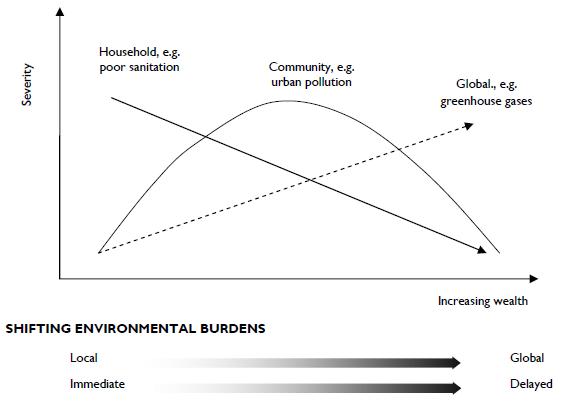
For many environmental pollutants, it has been observed that exposures tend to follow an inverted-U trajectory over time as exposures rise and then fall in parallel with increasing wealth, literacy and technological development. This is sometimes referred to as the 'environmental Kuznets' curve (figure)[2].
Low income populations tend to suffer most from households exposures, such as those relating to lack of access to clean water and sanitation, and exposure to indoor pollution from the inefficient and inadequately ventilated burning of biomass fuels for domestic cooking and heating.
Middle income populations on the other hand suffer more from community-level pollution, such as urban outdoor air pollution, contaminated water sources, and occupational hazards.
High income populations have, for the most part, reduced these risks, but contribute disproportionately to global problems, including greenhouse gas emissions, persistent organic pollutants (POPs), ozone-depleting gases, and urban non-biodegradable waste.
 |
Environmental burdens of disease
Global burdens of disease
|
It is difficult to provide definitive estimates of the environmental burden of disease because of issues of definition, incomplete evidence about aetiology, and the complexities of assessing exposures and their longer-term effects. But estimates suggest that somewhere between a quarter and a third of the global burden of disease and premature death is attributable to direct environmental risk factors.
The international Global Burden of Disease initiative has attempted to derive estimates of mortality and disability adjusted life years (DALYs) for selected causes. The mortality and DALYs attributed to childhood and maternal under-nutrition are given for comparison (table). For the environment they indicate that the largest burdens globally arise from unsafe water and sanitation and indoor smoke (both mainly affecting populations in the developing world), and outdoor air pollution (mainly affecting middle income populations, especially in Asia). The effects of global climate change are expected to grow substantially over time.
| |||||||||||||||||||||||||||
In 2014, WHO estimate that diarrhoeal disease accounts for approximately 3.6% of the total DALY global burden of disease, and of this it is estimated that 58% is attributable to unsafe water supply, sanitation and hygiene, most of which is in developing countries (WHO 2014).
Environment and disease risks
Although the risks of developing chronic diseases are attributed to both genetic and environmental factors, 70 to 90% of disease risks are probably due to differences in environments (1–3). Yet, epidemiologists increasingly use genome-wide association studies (GWAS) to investigate diseases, while relying on questionnaires to characterize “environmental exposures.” This is because GWAS represent the only approach for exploring the totality of any risk factor (genes, in this case) associated with disease prevalence. Moreover, the value of costly genetic information is diminished when inaccurate and imprecise environmental data lead to biased inferences regarding gene-environment interactions (4). A more comprehensive and quantitative view of environmental exposure is needed if epidemiologists are to discover the major causes of chronic diseases.
An obstacle to identifying the most important environmental exposures is the fragmentation of epidemiological research along lines defined by different factors. When epidemiologists investigate environmental risks, they tend to concentrate on a particular category of exposures involving air and water pollution, occupation, diet and obesity, stress and behavior, or types of infection. This slicing of the disease pie along parochial lines leads to scientific separation and confuses the definition of “environmental exposures.” In fact, all of these exposure categories can contribute to chronic diseases and should be investigated collectively rather than separately.
To develop a more cohesive view of environmental exposure, it is important to recognize that toxic effects are mediated through chemicals that alter critical molecules, cells, and physiological processes inside the body. Thus, it would be reasonable to consider the “environment” as the body’s internal chemical environment and “exposures” as the amounts of biologically active chemicals in this internal environment. Under this view, exposures are not restricted to chemicals (toxicants) entering the body from air, water, or food, for example, but also include chemicals produced by inflammation, oxidative stress, lipid peroxidation, infections, gut flora, and other natural processes (5, 6) (see the figure). This internal chemical environment continually fluctuates during life due to changes in external and internal sources, aging, infections, life-style, stress, psychosocial factors, and preexisting diseases.

Characterizing the exposome
The term “exposome” refers to the totality of environmental exposures from conception onwards, and has been proposed to be a critical entity for disease etiology (7). Recent discussion has focused on whether and how to implement this vision (8). Although fully characterizing human exposomes is daunting, strategies can be developed for getting “snapshots” of critical portions of a person’s exposome during different stages of life. At one extreme is a “bottom-up” strategy in which all chemicals in each external source of a subject’s exposome are measured at each time point. Although this approach would have the advantage of relating important exposures to the air, water, or diet, it would require enormous effort and would miss essential components of the internal chemical environment due to such factors as gender, obesity, inflammation, and stress. By contrast, a “top-down” strategy would measure all chemicals (or products of their downstream processing or effects, so-called read-outs or signatures) in a subject’s blood. This would require only a single blood specimen at each time point and would relate directly to the person’s internal chemical environment. Once important exposures have been identified in blood samples, additional testing could determine their sources and methods to reduce them.
To make the top-down approach feasible, the exposome would comprise a profile of the most prominent classes of toxicants that are known to cause disease, namely, reactive electrophiles, endocrine (hormone) disruptors, modulators of immune responses, agents that bind to cellular receptors, and metals. Exposures to these agents can be monitored in the blood either by direct measurement or by looking for their effects on physiological processes (such as metabolism). These processes generate products that serve as signatures and biomarkers in the blood. For example, reactive electrophiles, which constitute the largest class of toxic chemicals (6), cannot generally be measured in the blood. However, metabolites of electrophiles are detectable in serum (9), and products of their reactions with blood nucleophiles, like serum albumin, offer possible signatures (10). Estrogenic activity could be used to monitor the effect of endocrine disruptors and can be measured through serum biomarkers. Immune modulators trigger the production of cytokines and chemokines that also can be measured in serum. Chemicals that bind to cellular receptors stimulate the production of serum biomarkers that can be detected with high-throughput screens (11). Metals are readily measured in blood (12), as are hormones, antibodies to pathogens, and proteins released by cells in response to stress. The accumulation of biologically important exposures may also be detected as changes to lymphocyte gene expression or in chemical modifications of DNA (such as methylation) (13).
The environmental equivalent of a GWAS is possible when signatures and biomarkers of the exposome are characterized in humans with known health outcomes. Indeed, a relevant prototype for such a study examined associations between type 2 diabetes and 266 candidate chemicals measured in blood or urine (14). It determined that exposure to certain chemicals produced strong associations with the risk of type 2 diabetes, with effect sizes comparable to the strongest genetic loci reported in GWAS. In another study, chromosome (telomere) length in peripheral blood mononuclear cells responded to chronic psychological stress, possibly mediated by the production of reactive oxygen species (15).
Characterizing the exposome represents a technological challenge like that of the human genome project, which began when DNA sequencing was in its infancy (16). Analytical systems are needed to process small amounts of blood from thousands of subjects. Assays should be multiplexed for measuring many chemicals in each class of interest. Tandem mass spectrometry, gene and protein chips, and microfluidic systems offer the means to do this. Platforms for high-throughput assays should lead to economies of scale, again like those experienced by the human genome project. And because exposome technologies would provide feedback for therapeutic interventions and personalized medicine, they should motivate the development of commercial devices for screening important environmental exposures in blood samples.
With successful characterization of both exposomes and genomes, environmental and genetic determinants of chronic diseases can be united in high-resolution studies that examine gene-environment interactions. Such a union might even push the nature-versus-nurture debate toward resolution.
References and Notes
1. Lichtenstein P, et al. N. Engl. J. Med. 2000;343:78. [PubMed]
2. Hindorff LA, et al. Proc. Natl. Acad. Sci. U.S.A. 2009;106:9362. [PMC free article] [PubMed]
3. Willett WC. Science. 2002;296:695. [PubMed]
4. Vineis P. Int. J. Epidemiol. 2004;33:945. [PubMed]
5. Dalle-Donne I, et al. Clin. Chem. 2006;52:601. [PubMed]
6. Liebler DC. Chem. Res. Toxicol. 2008;21:117. [PMC free article] [PubMed]
7. Wild CP. Cancer Epidemiol. Biomarkers Prev. 2005;14:1847. [PubMed]
9. Dunn WB, et al. Int. J. Epidemiol. 2008;37(suppl. 1):i23. [PubMed]
10. Rubino FM, et al. Mass Spectrom Rev. 2009;28:725. [PubMed]
11. Halldorsson TI, et al. Environ. Res. 2009;109:22. [PubMed]
12. Mounicou S, et al. Chem. Soc. Rev. 2009;38:1119. [PubMed]
13. McHale CM, et al. Mutat. Res. 2010 10.1016/j.mrrev.2010.04.001. [PMC free article] [PubMed]
14. Patel CJ, et al. PLoS ONE. 2010;5:e10746. [PMC free article] [PubMed]
15. Epel ES, et al. Proc. Natl. Acad. Sci. U.S.A. 2004;101:17312. [PMC free article] [PubMed]
16. Collins FS, et al. Science. 2003;300:286. [PubMed]
What diseases are caused by the environment?
Environmental diseases are those diseases caused due to the environmental factors and are not transmitted through genes or by any other infection (Donald, 1991). Exposure to harmful chemicals, pesticides, radiation, air pollution and water pollution exposure to toxins, pathogens, radiation, and chemicals found in almost all personal care products and household cleaners are possible causes of a large segment of environmental diseases (Titlow, 1999). These disease-causing agents are present every where around us and therefore, the possibility of a person getting infected depends on the hazards present in their environment as well as their genetic vulnerability to these diseases (Donald, 1991). This paper provides a brief description of the common environmental diseases. These include lung diseases, asthma, bronchitis, black lung disease, cancer and kidney diseases.
Lung Diseases
Lung diseases are one of the most common environmental Diseases (WHO, 2010). These include: Asthma, Bronchitis, Lung cancer, Black lung disease, Silicosis cancers and. Some of these diseases have been linked to environmental toxins such as pesticides, herbicides, cigarette smoke, asbestos, radiation, natural and man-made chemicals, alcohol, and ultraviolet radiation from sunlight and radioactive substances some of which are present in the environment.
Asthma
According to National Asthma Education and Prevention Program (2007), Asthma is an inflammatory disorder of the airways, which causes attacks of wheezing, shortness of breath, chest tightness, and coughing. When an asthma attack occurs, the muscles surrounding the airways become tight and the lining of the air passages swells. This reduces the amount of air that can pass by (Wechsler, 2009). In sensitive people, asthma symptoms can be triggered by breathing in allergy-causing substances (called allergens or triggers) common asthma triggers include: Dust Chemicals in the air, food or Tobacco smoke (Fanta, 2009).
According to NAEPP (2007), some of the preventive measures against asthma are avoiding known triggers and substances that irritate the airways. Persons with asthma should also avoid air pollution, industrial dusts, and other irritating fumes as much as possible, beddings should also be covered with allergy-proof casings to reduce exposure to dust mites, houses should be kept clean and food in containers and out of bedrooms. This practices help reduce the possibility of cockroaches, which can trigger asthma attacks in some people also filtering material should be placed over the heating outlets to trap animal dander. In addition, tobacco smoke should be eliminated from home.
Bronchitis
Bronchitis, an inflammation of the airways of the lungs, can be caused by breathing in certain chemicals or smoke (Hueston, 1997). According to Mosby (2004), smokers are at a increased risk for the development of chronic bronchitis thus most cases of chronic bronchitis are caused by smoking cigarettes or other forms of tobacco. Chronic inhalation of irritating fumes or dust from occupational exposure or air pollution may also be causative agent. The most effective method of preventing chronic bronchitis and other forms of lung diseases is to avoid smoking cigarettes and other forms of tobacco (Goldsobel, 2010).
Black lung disease
According to National Health Service (2010), Black lung disease is a common name for any lung disease developing from inhaling coal dust. This name comes from the fact that those with the disease have lungs that look black instead of pink. Medically, it is a type of pneumoconiosis. There are two forms: simple, which is known as coal workers pneumoconiosis (CWP); and complicated, which is known as progressive massive fibrosis (PMF).Some of the preventive measures against Black lung disease are wearing a protective mask when working around coal, graphite, or man-made carbon mines. The other measure is more companies should enforce the maximum permitted dust levels.
Cancer
Cancer occurs when a cell or group of cells begins to multiply more rapidly than normal. As the cancer cells spread, they affect nearby organs and tissues in the body. Eventually, the organs are not able to perform their normal functions (Benivia, 2008). Some of the causes of cancer are caused by substances in the environment: cigarette smoke, asbestos, radiation, natural and man-made chemicals, alcohol, and excessive exposure to ultraviolet radiation in sunlight (Wechsler, 2009). People can reduce their risk of getting cancer by limiting their exposure to these harmful agents.
Lung cancer is one typical example of cancer. It is a malignant tumor that invades and obstructs the lung’s air passages (WHO, 2010). Cigarette smoking greatly increases the likelihood of a person developing lung cancer. Further more, exposure to asbestos increase the likely hood of one to contract lung cancer. The most common symptoms of lung cancer are cough, wheezing, unexplained weight loss, coughing up blood, and labored breathing. Other symptoms of lung cancer include shortness of breath, persistent chest pain, hoarseness, and anemia (Wechsler, 2009). People who develop these symptoms do not necessarily have lung cancer, but should consult a physician for advice (National Health Service, 2010).
Kidney Diseases
According to National Center for Environmental Health (2009), Kidney diseases range from simple infections to total kidney failure. Individual with kidney failure cannot remove wastes and poisons from their blood. Cause of kidney diseases include chemicals found in the environment, using large numbers of over-the-counter pain relievers for a long time also using of drugs such as heroin and crack. Further more, toxins such as pesticides can also result in kidney problems (National Health Service, 2010).
The list of environmental related diseases is long. The diseases that have been discussed in this paper, namely lung diseases, asthma, bronchitis, black lung disease, cancer and kidney diseases are just but the common ones. Effective implementation of the measures to counter the effect of these diseases on human health remains the biggest hurdle.
References
Benivia, G. (2008). Environmental Health & Safety. Retrieved on 25th July from http://www.wiredforhealth.gov.uk/PDF/infect_poster.pdf
Donald, H. (1991).The Diseases of Occupations, Sixth Edition, , Hodder and Stoughton,London. ISBN 0-340-22084-8, 1978. Aviat Space Environ Med. 62(8):795-7.
Goldsobel, A. (2010). “Cough in the pediatric population“. J. Pediatr. 156 (3): 352–358.e1. doi:10.1016/j.jpeds.2009.12.004. PMID 20176183.
Hueston, W. (1997). Antibiotics: neither cost-effective nor ‘cough’ effective. The Journal of Family Practice 44 (3): 261–5. PMID 9071245.
Fanta, C. (2009). Asthma. N. Engl. J, Med.;360:1002-1014. [PubMed: 19264689] University of Washington School.
Mosby, E. (2004). “Chapter 33: Bronchitis, Bronchiectasis, and Cystic Fibrosis”
National Asthma Education and Prevention Program (2007).Guidelines for the Diagnosis and Management of Asthma. US Dept of Health and Human Services; NIH publication 08-4051.
National Health Service (NHS) (2010). Physical Health Fitness, National Institutes of Health, USA.
Titlow, B. (1999). Health events. Coast Guard Office of Health Services, Washington, D.C.
Wechsler, M. (2009). Managing asthma in primary care: putting new guideline recommendations into context. Mayo Clin Proc., 84:707-717.: 19648388
WHO (2009) Disease in Europe. Retrieved 22nd July 2011 from http://www.eea.europa.eu/soer/countries/nl/national-and-regional-story-netherlands
WHO (2010) Environmental Burden of Disease in Europe. Retrieved 22nd July 2011 from http://www.eea.europa.eu/soer/countries/nl/national-and regional-story-netherlands.
Subscribe to:
Posts (Atom)